Crossbeam • 2023
Closing Deals Faster by Taking Account Mapping into a Partner Ecosystem
0→1
B2B Sales
Enterprise
SaaS
Acquisition
Collaboration
Attribution
Crossbeam is a partner ecosystem platform for B2B sales teams. It gives companies the infrastructure to manage partner relationships, from identifying shared accounts through account mapping to tracking how those partnerships influence and close revenue.
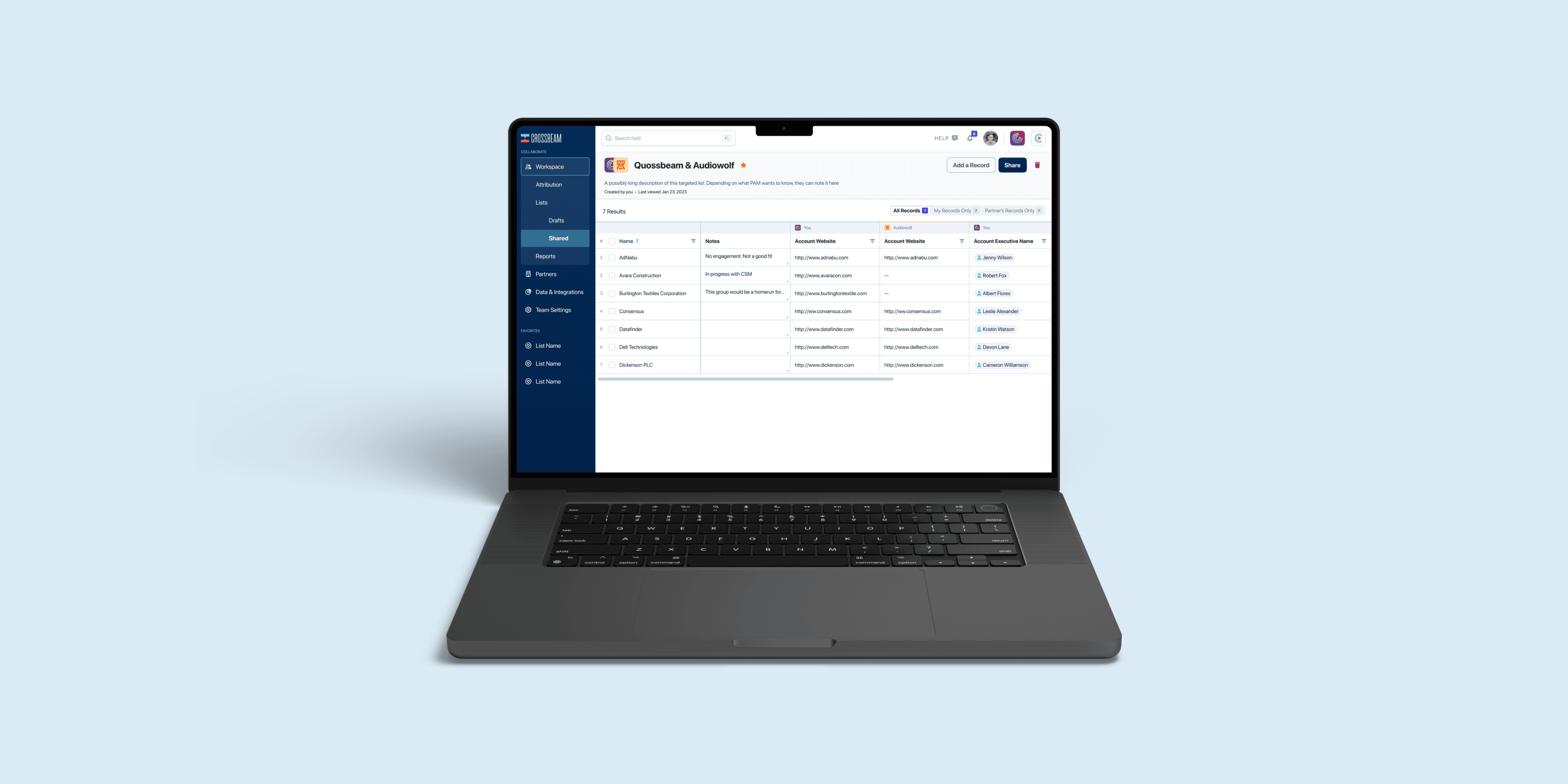
I led 2 new teams and laid the foundation for the 2023 roadmap
I was responsible for designing 2 new features in 8 weeks, taking Crossbeam from a single product to a platform for Partner Account Managers to close deals
I led 2 new teams and laid the foundation for the 2023 roadmap
I was responsible for designing 2 new features in 8 weeks, taking Crossbeam from a single product to a platform for Partner Account Managers to close deals
I led 2 new teams and laid the foundation for the 2023 roadmap
I was responsible for designing 2 new features in 8 weeks, taking Crossbeam from a single product to a platform for Partner Account Managers to close deals
2 Teams
Lead designer across 2 new product teams
8 Weeks
Weeks to beta / Shipped Q3-Q4
17 Interviews
Customer interviews and observations
100%
of customers interviewed wanted this
2 Teams
Lead designer across 2 new product teams
8 Weeks
Weeks to beta / Shipped Q3-Q4
17 Interviews
Customer interviews and observations
100%
of customers interviewed wanted this
2 Teams
Lead designer across 2 new product teams
8 Weeks
Weeks to beta / Shipped Q3-Q4
17 Interviews
Customer interviews and observations
100%
of customers interviewed wanted this
Overview
In 8 weeks, across two new teams, I designed 2 new features that moved Crossbeam from a single account mapping tool into a platform ecosystem for partner-led deals. Shared Lists and Attribution shipped into beta by end of Q1 and launched fully in Q3-Q4 2023.
The vertical navigation model I identified and designed as part of this work was adopted across the product. Every customer interviewed during discovery asked for both products.
I also identified this work to be the data foundation to capture the right attribution signals from day one, Crossbeam could eventually predict which partner actions accelerate deals, recommend next steps to PAMs, and surface intelligence that no spreadsheet-based workflow could ever produce. We see this today (2026) with Crossbeam's Deal Navigator feature.
Overview
In 8 weeks, across two new teams, I designed 2 new features that moved Crossbeam from a single account mapping tool into a platform ecosystem for partner-led deals. Shared Lists and Attribution shipped into beta by end of Q1 and launched fully in Q3-Q4 2023.
The vertical navigation model I identified and designed as part of this work was adopted across the product. Every customer interviewed during discovery asked for both products.
I also identified this work to be the data foundation to capture the right attribution signals from day one, Crossbeam could eventually predict which partner actions accelerate deals, recommend next steps to PAMs, and surface intelligence that no spreadsheet-based workflow could ever produce. We see this today (2026) with Crossbeam's Deal Navigator feature.
Overview
In 8 weeks, across two new teams, I designed 2 new features that moved Crossbeam from a single account mapping tool into a platform ecosystem for partner-led deals. Shared Lists and Attribution shipped into beta by end of Q1 and launched fully in Q3-Q4 2023.
The vertical navigation model I identified and designed as part of this work was adopted across the product. Every customer interviewed during discovery asked for both products.
I also identified this work to be the data foundation to capture the right attribution signals from day one, Crossbeam could eventually predict which partner actions accelerate deals, recommend next steps to PAMs, and surface intelligence that no spreadsheet-based workflow could ever produce. We see this today (2026) with Crossbeam's Deal Navigator feature.
Crossbeam
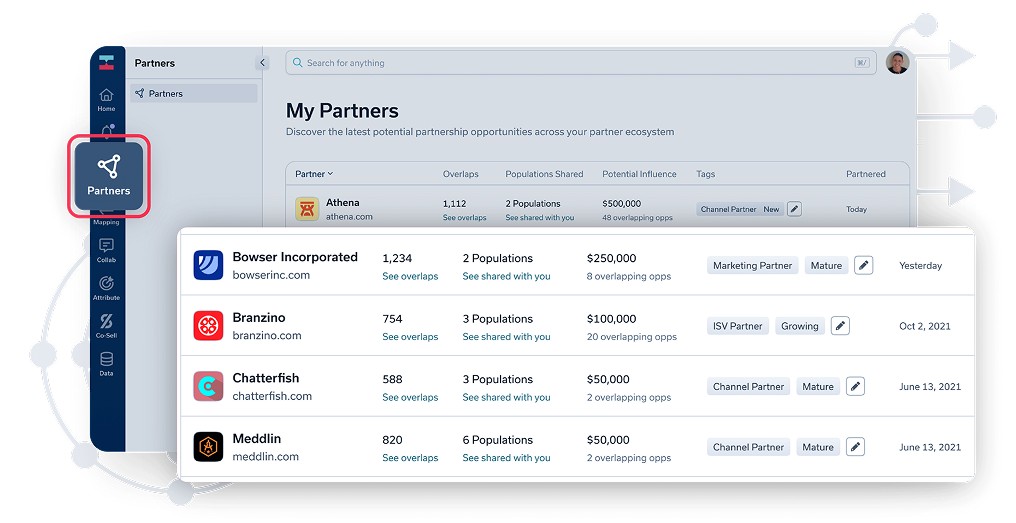
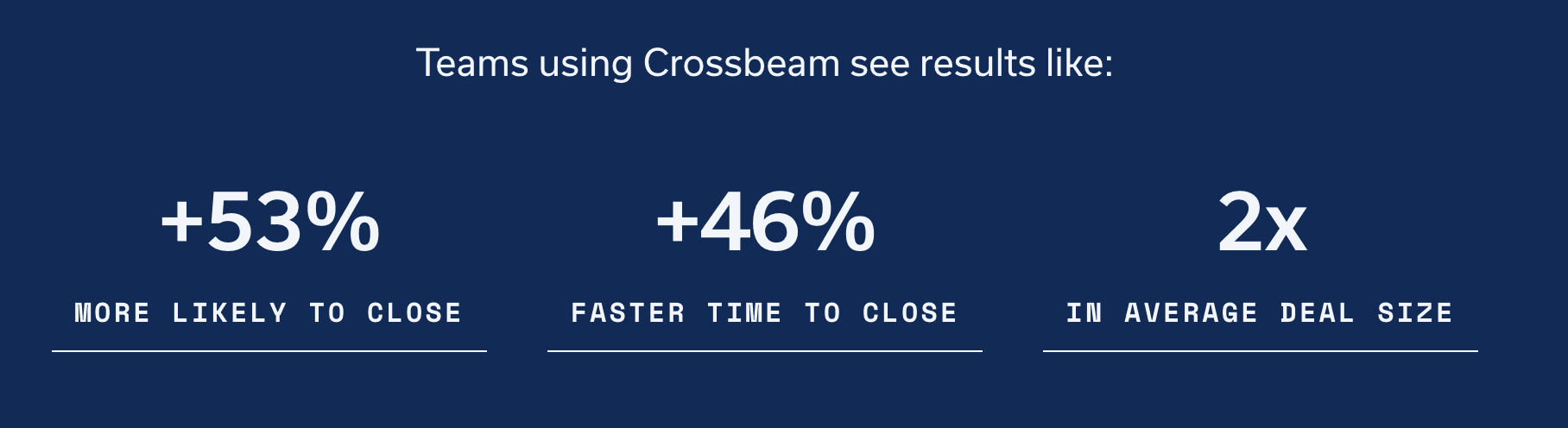
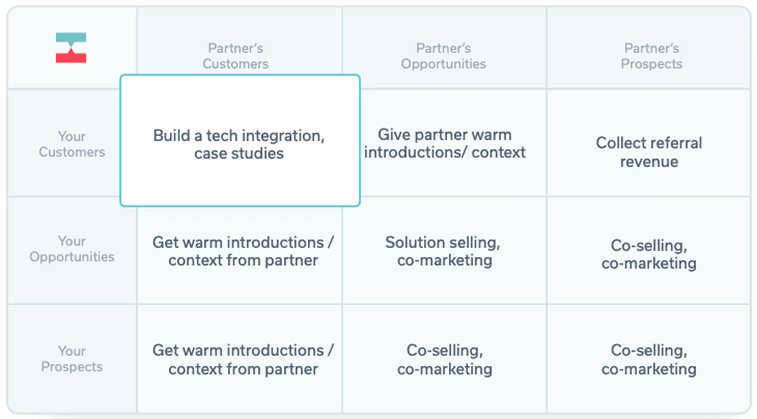
A platform for partner led sales, where deals are higher value, longer cycle, and require close collaboration between companies.
Crossbeam provides the infrastructure to manage these relationships, from identifying opportunities (account mapping) to tracking influence on closed revenue.
Account Groups & Overlaps
Use Cases
Crossbeam
A platform for partner led sales, where deals are higher value, longer cycle, and require close collaboration between companies.
Crossbeam provides the infrastructure to manage these relationships, from identifying opportunities (account mapping) to tracking influence on closed revenue.
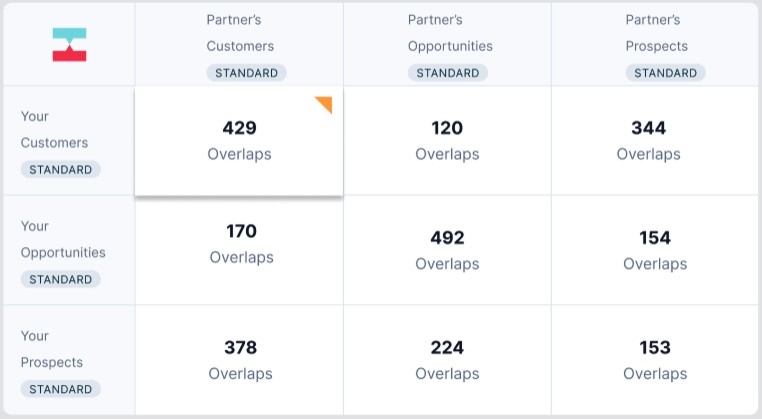
Account Groups & Overlaps
Use Cases
Crossbeam
A platform for partner led sales, where deals are higher value, longer cycle, and require close collaboration between companies.
Crossbeam provides the infrastructure to manage these relationships, from identifying opportunities (account mapping) to tracking influence on closed revenue.
Account Groups & Overlaps
Use Cases
Account mapping solved setup but not how deals actually get done
Account mapping solved setup but not how deals actually get done
Account mapping solved setup but not how deals actually get done
New Features
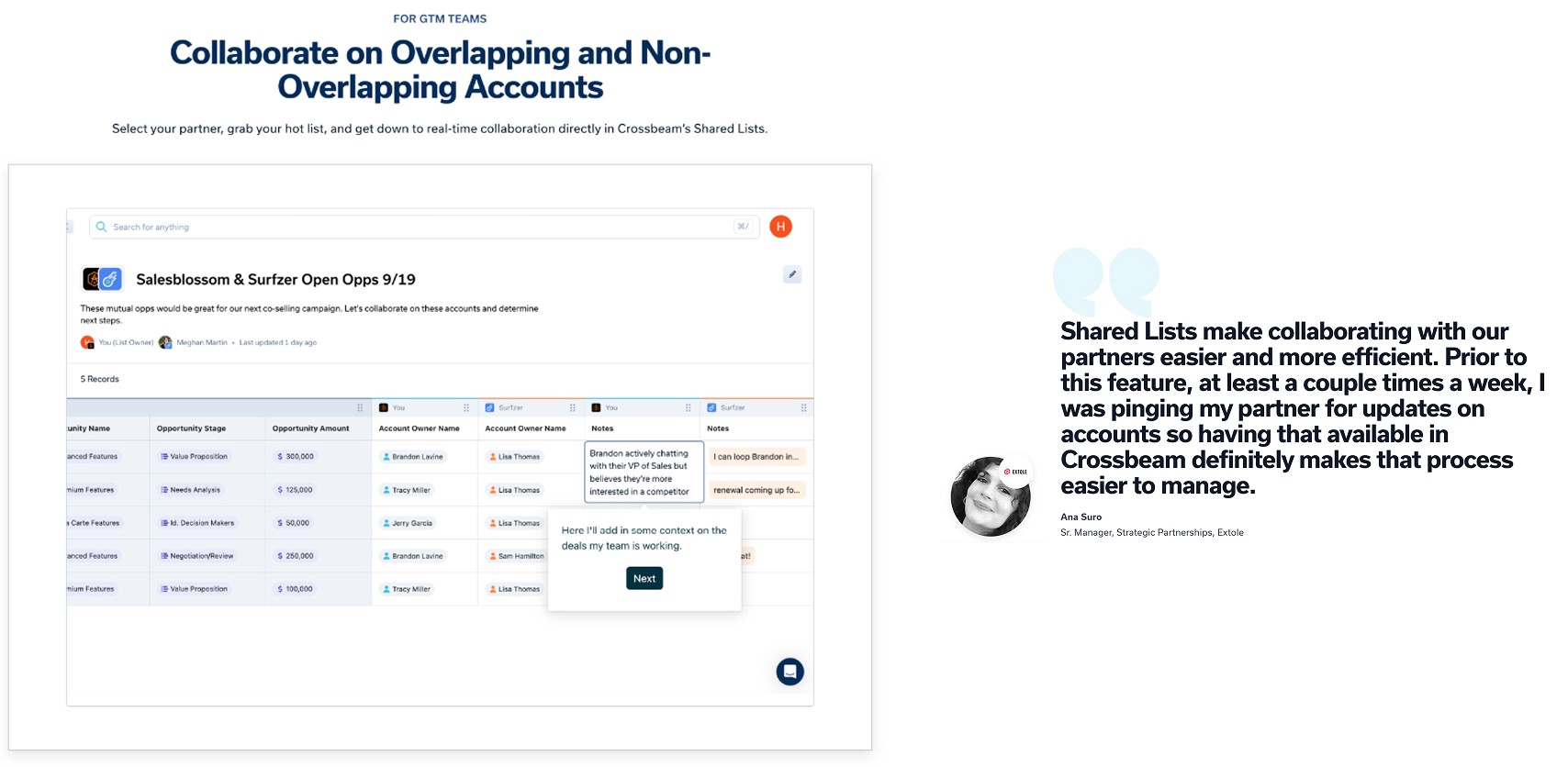
Shared Lists
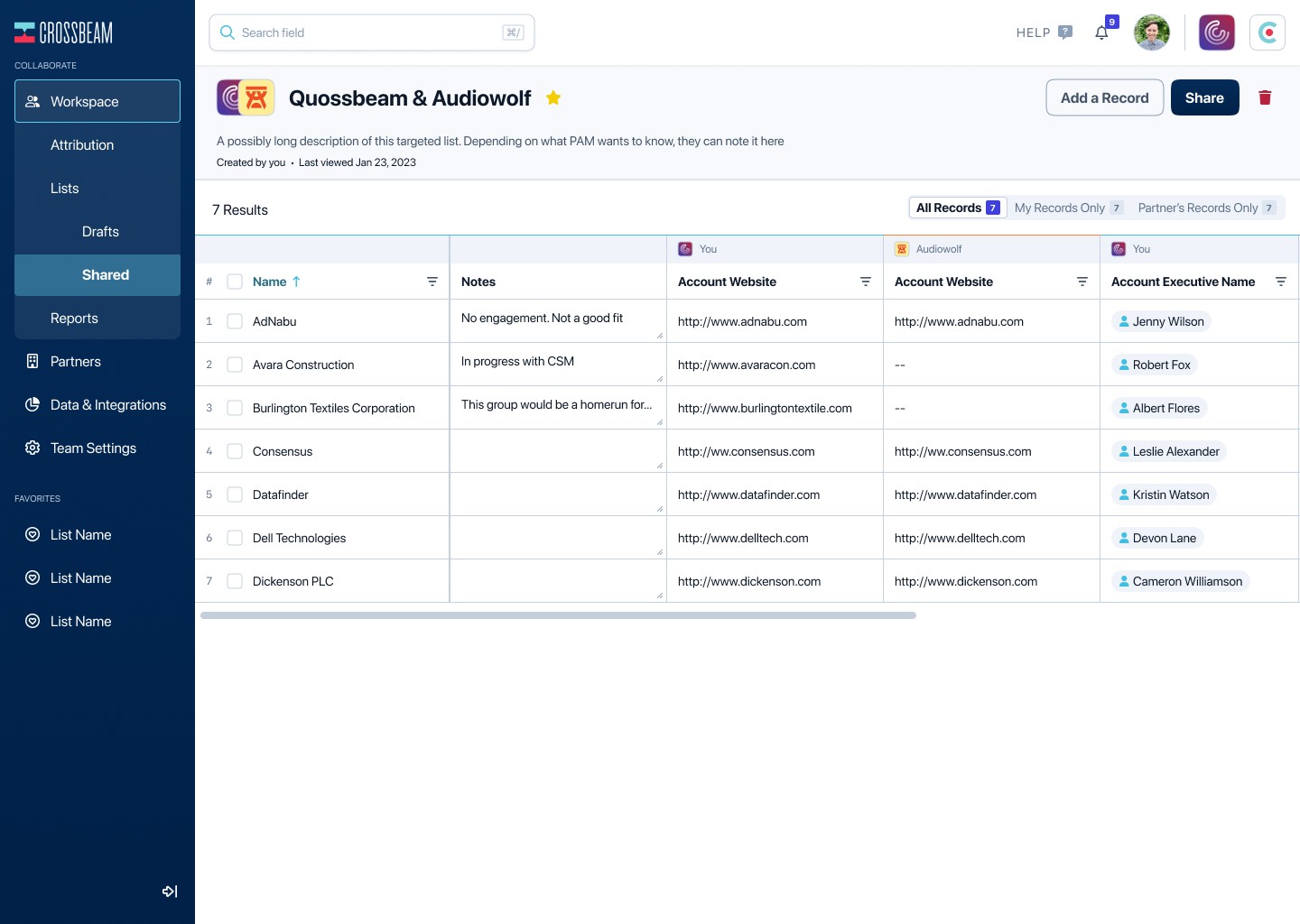
A dedicated space for PAMs to create targeted account lists from their account mapping data, share them with a partner, and collaborate directly in Crossbeam.
No CSV exports. No versioned spreadsheets. No calls to negotiate what was already written down.
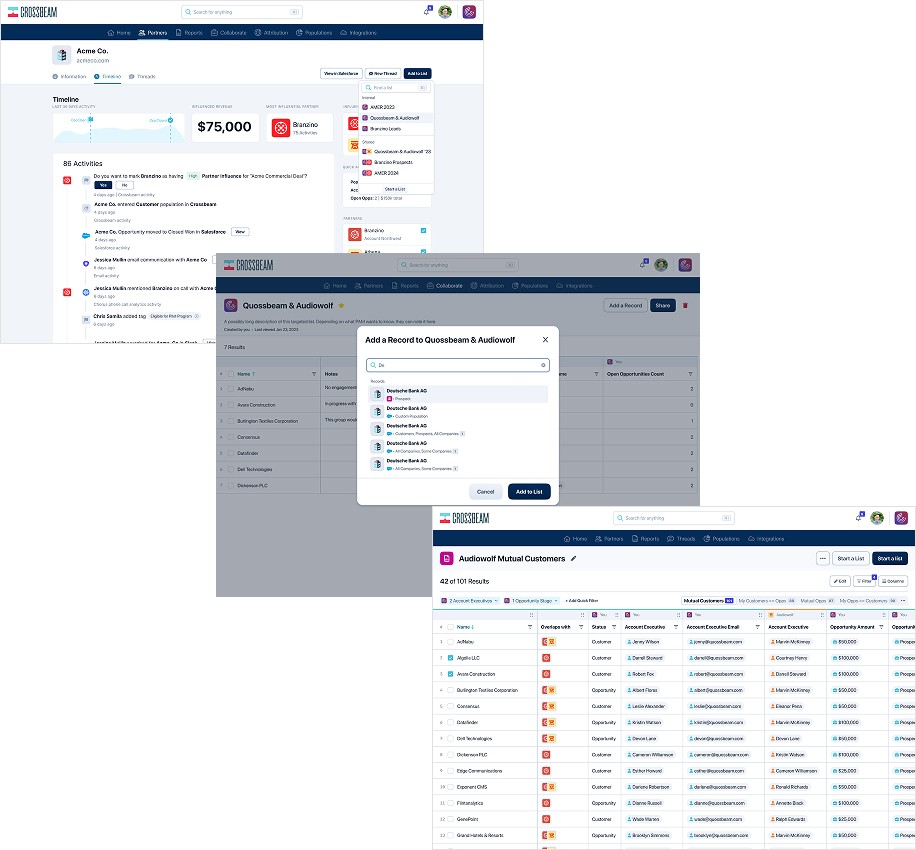
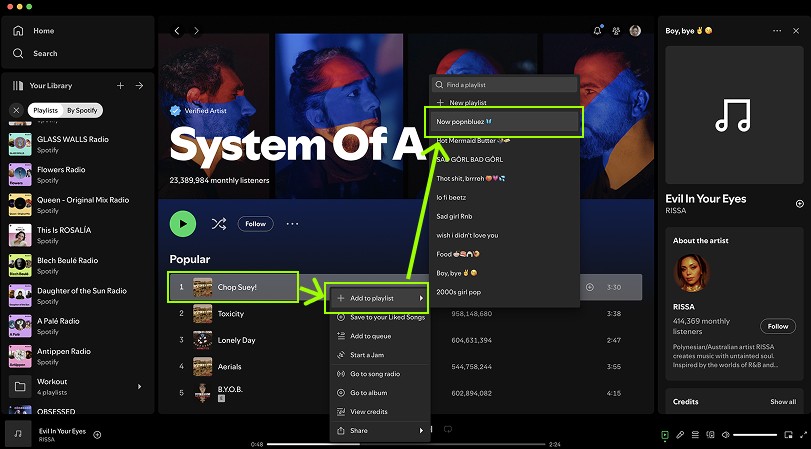
Lists could be created from an account map report or directly from the Collaborate space. Sharing settings were architected separately from the existing population-sharing infrastructure to avoid data privacy complexity. The interface drew on a familiar mental model: think Spotify playlists for account management, short and curated, not comprehensive.
New Features
Shared Lists
A dedicated space for PAMs to create targeted account lists from their account mapping data, share them with a partner, and collaborate directly in Crossbeam.
No CSV exports. No versioned spreadsheets. No calls to negotiate what was already written down.
Lists could be created from an account map report or directly from the Collaborate space. Sharing settings were architected separately from the existing population-sharing infrastructure to avoid data privacy complexity. The interface drew on a familiar mental model: think Spotify playlists for account management, short and curated, not comprehensive.
New Features
Shared Lists
A dedicated space for PAMs to create targeted account lists from their account mapping data, share them with a partner, and collaborate directly in Crossbeam.
No CSV exports. No versioned spreadsheets. No calls to negotiate what was already written down.
Lists could be created from an account map report or directly from the Collaborate space. Sharing settings were architected separately from the existing population-sharing infrastructure to avoid data privacy complexity. The interface drew on a familiar mental model: think Spotify playlists for account management, short and curated, not comprehensive.
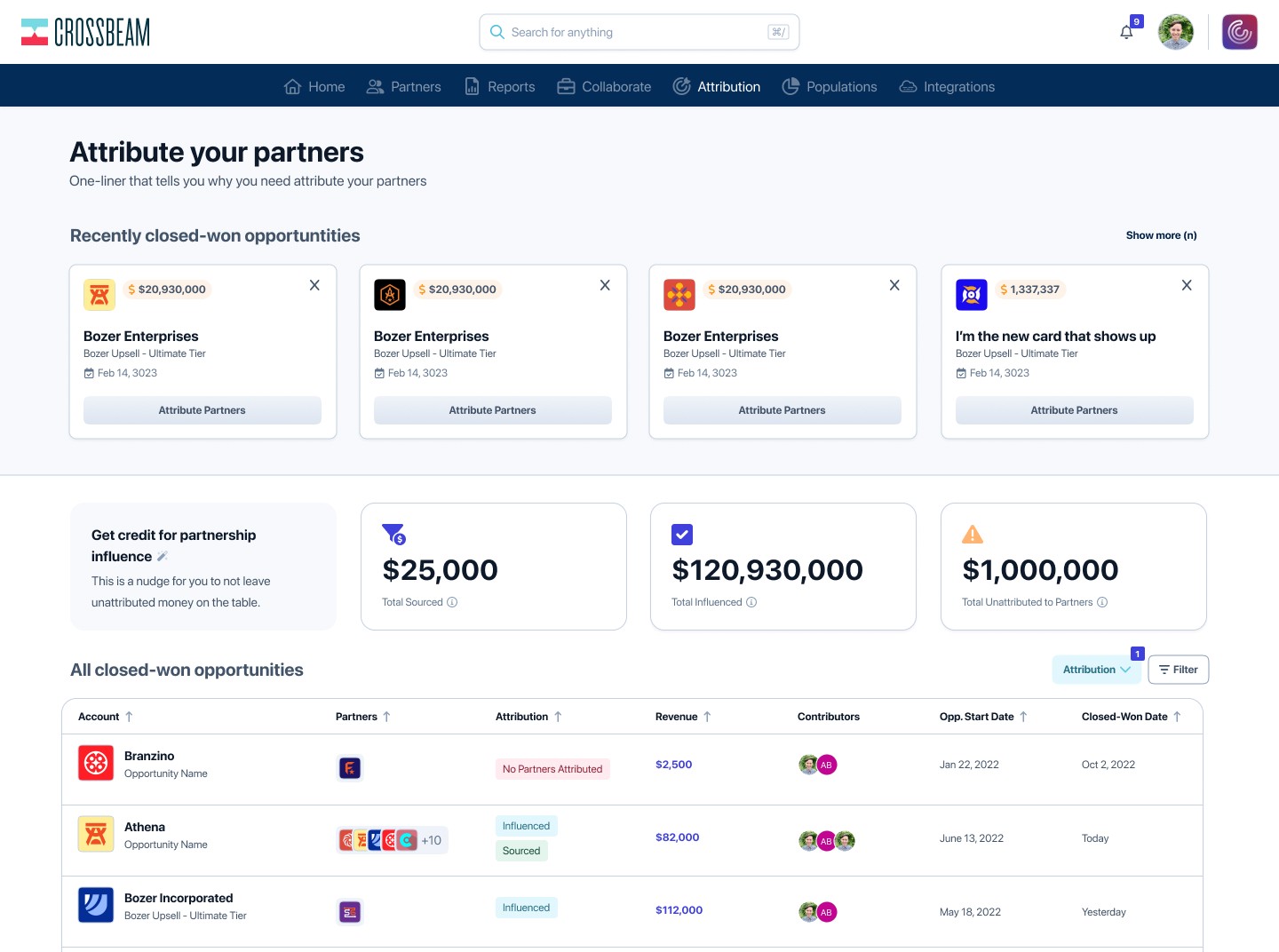
Attribution
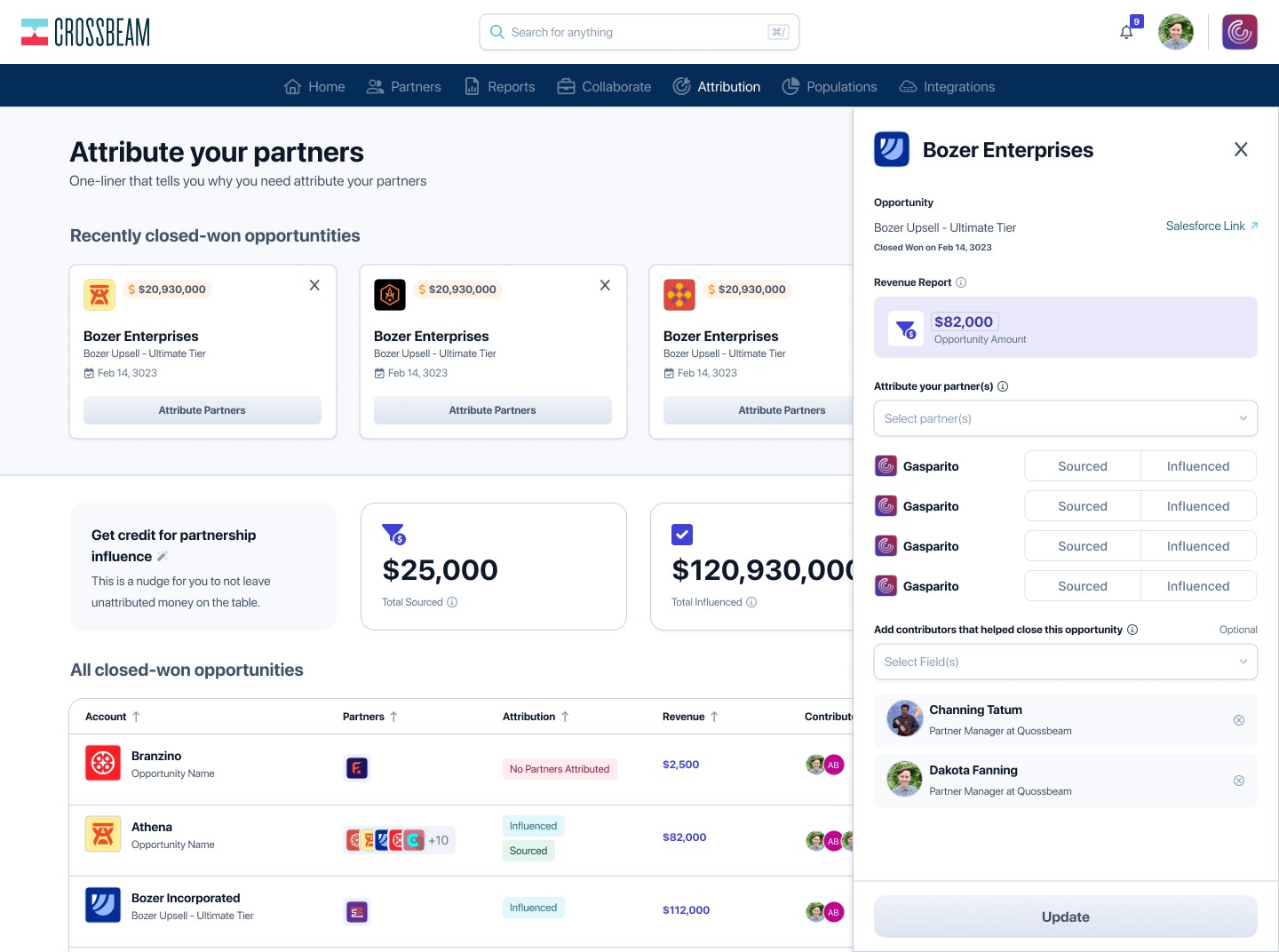
A place to record which partner actions contributed to closed-won revenue, with summary metrics PAMs could use in conversations about their impact with leadership and sales.
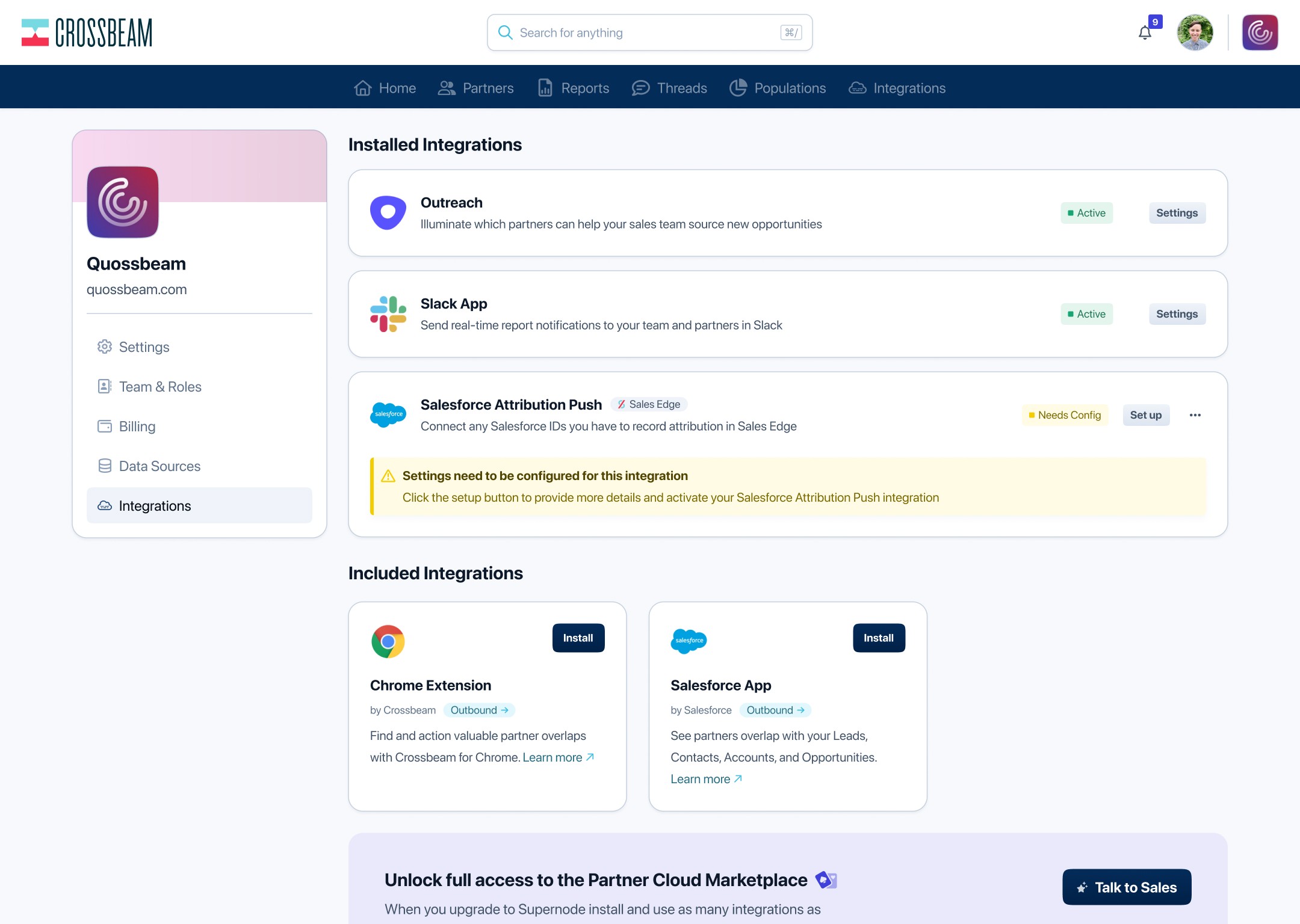
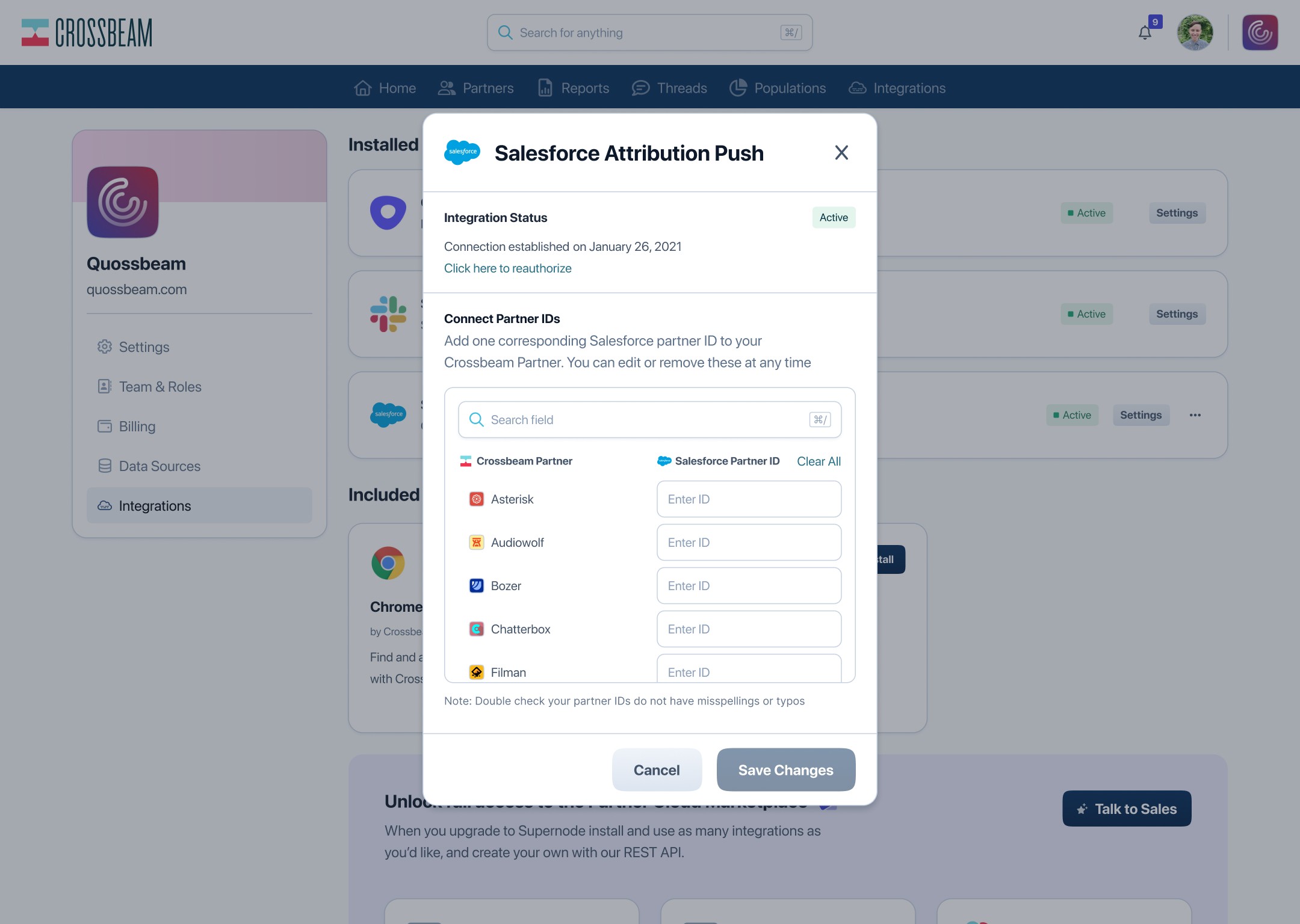
The Salesforce integration was still being built when we designed this. Rather than wait or ship a placeholder, we designed a manual input experience that was as low-friction as possible, with clear validation states, copy shortcuts, and an architecture that could extend once the integration was ready without requiring a redesign.
More importantly, the attribution model was designed to capture more than deal outcomes. It was designed to capture the interactions that led there: the co-selling motion, the partner introduction, the event that predicated the close. That signal was the foundation for the intelligence layer that could come later.
Attribution
A place to record which partner actions contributed to closed-won revenue, with summary metrics PAMs could use in conversations about their impact with leadership and sales.
The Salesforce integration was still being built when we designed this. Rather than wait or ship a placeholder, we designed a manual input experience that was as low-friction as possible, with clear validation states, copy shortcuts, and an architecture that could extend once the integration was ready without requiring a redesign.
More importantly, the attribution model was designed to capture more than deal outcomes. It was designed to capture the interactions that led there: the co-selling motion, the partner introduction, the event that predicated the close. That signal was the foundation for the intelligence layer that could come later.
Attribution
A place to record which partner actions contributed to closed-won revenue, with summary metrics PAMs could use in conversations about their impact with leadership and sales.
The Salesforce integration was still being built when we designed this. Rather than wait or ship a placeholder, we designed a manual input experience that was as low-friction as possible, with clear validation states, copy shortcuts, and an architecture that could extend once the integration was ready without requiring a redesign.
More importantly, the attribution model was designed to capture more than deal outcomes. It was designed to capture the interactions that led there: the co-selling motion, the partner introduction, the event that predicated the close. That signal was the foundation for the intelligence layer that could come later.
Want to see the designs?
Want to see the designs?
Want to see the designs?
The Problem
Partner Account Managers needed to close deals faster and with more predictability.
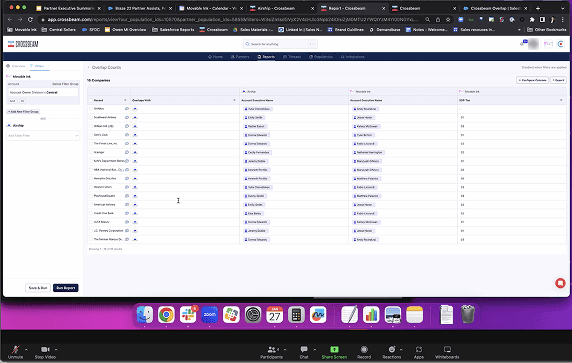
To move deals forward, they relied on spreadsheets, disconnected tools, and constant calls, fragmentation that increased manual effort, slowed deal velocity, and made partner attribution unclear.
Most of the time, attribution did not happen at all. When it did, it was a Vlookup and a best guess entered into a CRM after the fact.
Partner teams could not prove their value. Crossbeam could not show that its data was driving revenue. And because none of those interactions were being captured anywhere, there was no data to learn from, no signal to act on, no way to get smarter over time.
The Problem
Partner Account Managers needed to close deals faster and with more predictability.
To move deals forward, they relied on spreadsheets, disconnected tools, and constant calls, fragmentation that increased manual effort, slowed deal velocity, and made partner attribution unclear.
Most of the time, attribution did not happen at all. When it did, it was a Vlookup and a best guess entered into a CRM after the fact.
Partner teams could not prove their value. Crossbeam could not show that its data was driving revenue. And because none of those interactions were being captured anywhere, there was no data to learn from, no signal to act on, no way to get smarter over time.
The Problem
Partner Account Managers needed to close deals faster and with more predictability.
To move deals forward, they relied on spreadsheets, disconnected tools, and constant calls, fragmentation that increased manual effort, slowed deal velocity, and made partner attribution unclear.
Most of the time, attribution did not happen at all. When it did, it was a Vlookup and a best guess entered into a CRM after the fact.
Partner teams could not prove their value. Crossbeam could not show that its data was driving revenue. And because none of those interactions were being captured anywhere, there was no data to learn from, no signal to act on, no way to get smarter over time.
Our challenge wasn’t feature design, it was designing for today’s workflows and tomorrow’s intelligence
Our challenge wasn’t feature design, it was designing for today’s workflows and tomorrow’s intelligence
Our challenge wasn’t feature design, it was designing for today’s workflows and tomorrow’s intelligence
OKR's
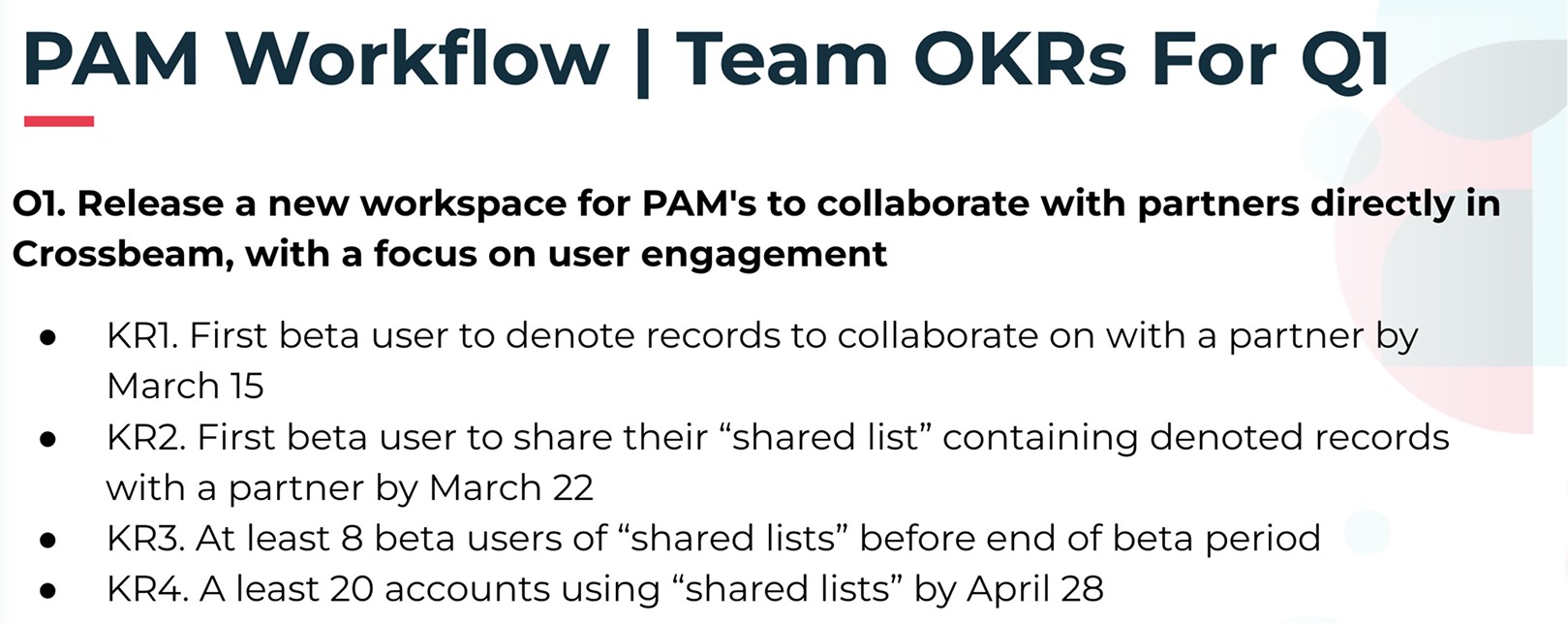
OKR's
OKR's
Assumptions
These were the assumptions made which is why the timeline was aggressive, building on existing infrastructure shouldn't take as long as building net-new
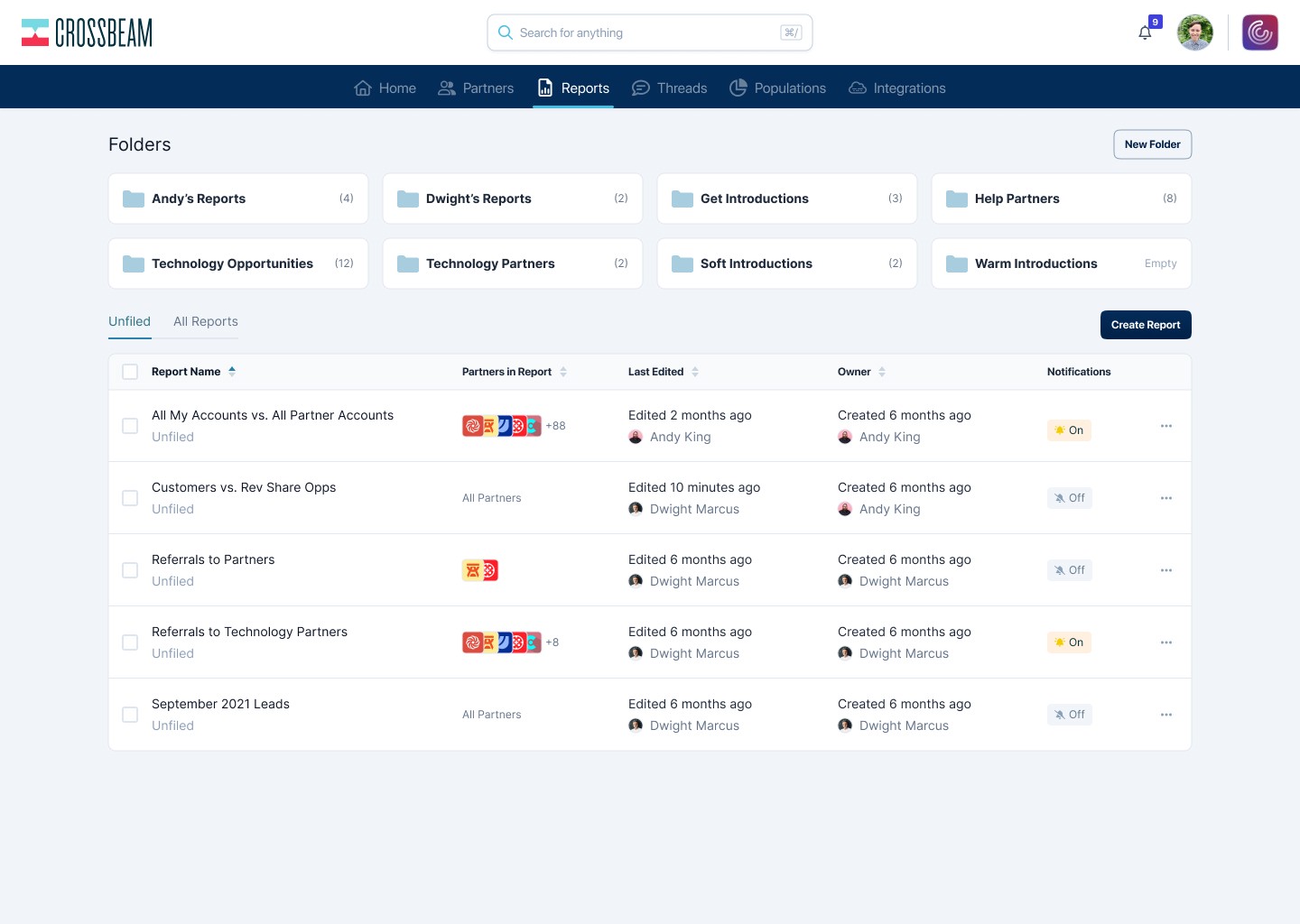
Existing Reports Page
Account collaboration built within reports
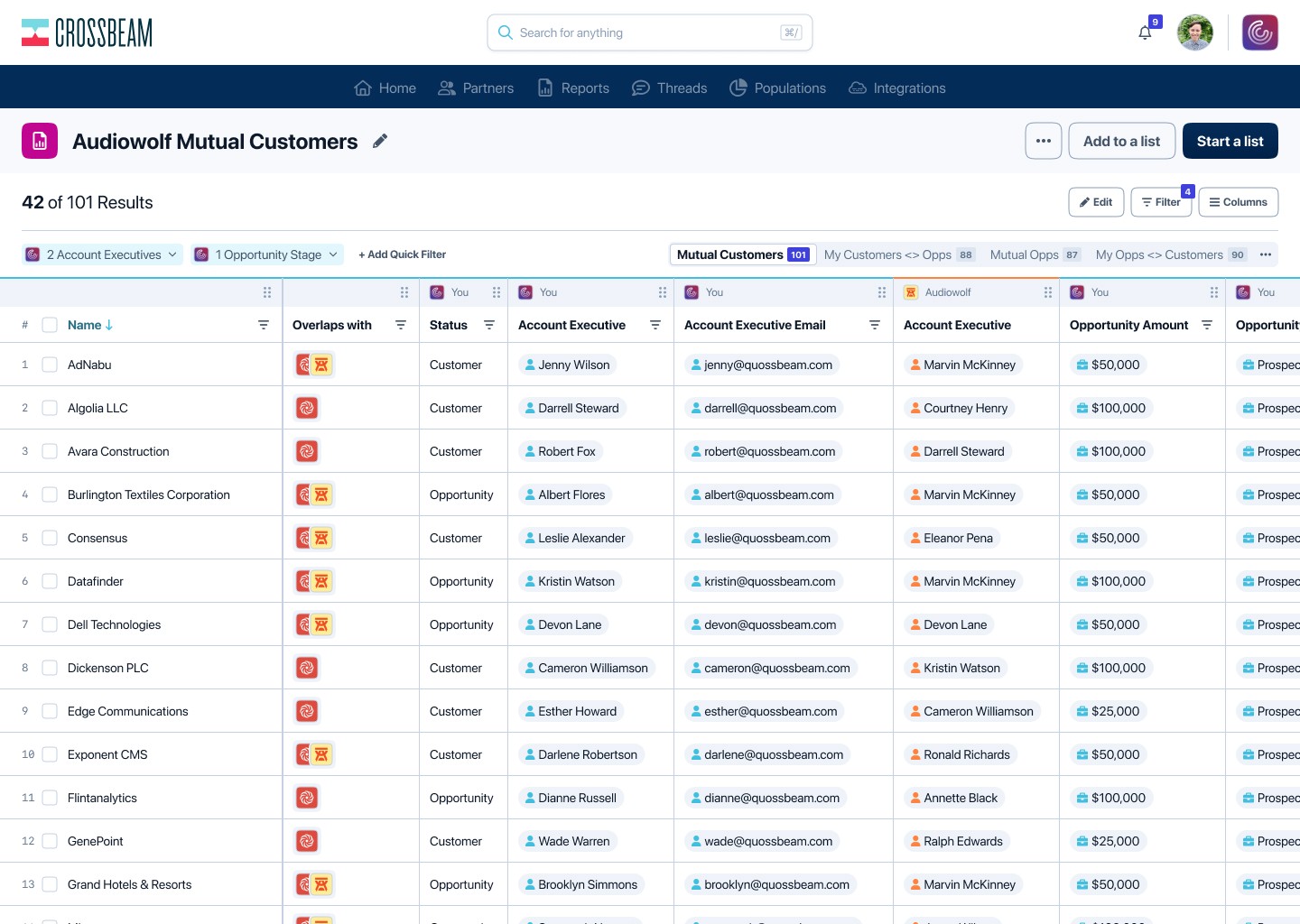
Filter on Existing Reports
Additional filters to the account map report
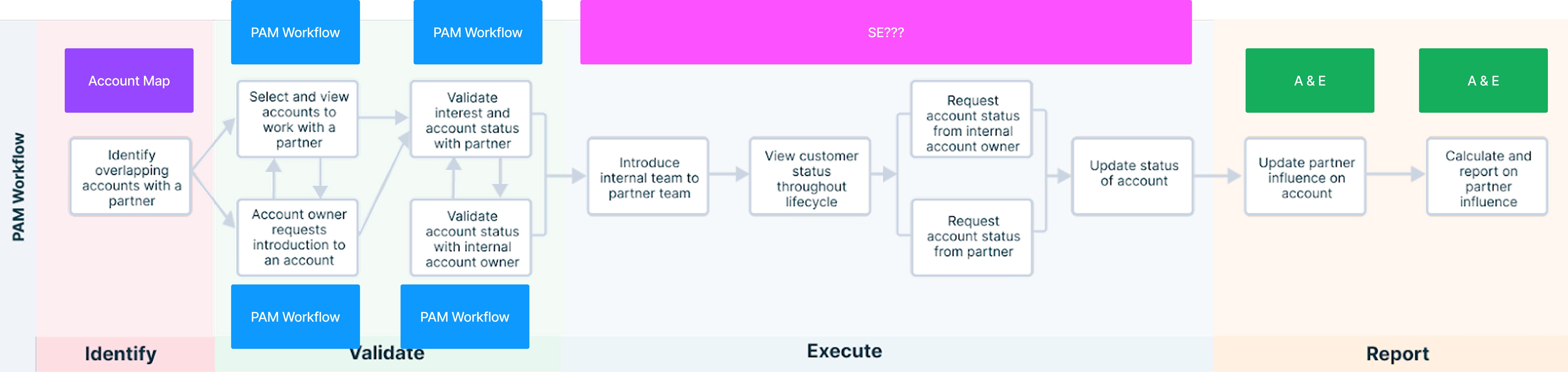
The PAM Workflow
The order of a PAM's workflow starts with account mapping
Assumptions
These were the assumptions made which is why the timeline was aggressive, building on existing infrastructure shouldn't take as long as building net-new
Existing Reports Page
Account collaboration built within reports
Filter on Existing Reports
Additional filters to the account map report
The PAM Workflow
The order of a PAM's workflow starts with account mapping
Assumptions
These were the assumptions made which is why the timeline was aggressive, building on existing infrastructure shouldn't take as long as building net-new
Existing Reports Page
Account collaboration built within reports
Filter on Existing Reports
Additional filters to the account map report
The PAM Workflow
The order of a PAM's workflow starts with account mapping
Constraints
Time
8 weeks to beta
New Teams
Two brand-new teams with no established design patterns for these areas
Design System
A limited design system that required component decisions to be made in parallel with feature design
Salesforce Dependency
A Salesforce dependency that was not resolved by launch and being worked on in tandem
Tradeoffs
Needing to ship both products fast required tradeoffs like smarter partner search, automated attribution matching, and a more sophisticated data privacy model
Constraints
Time
8 weeks to beta
New Teams
Two brand-new teams with no established design patterns for these areas
Design System
A limited design system that required component decisions to be made in parallel with feature design
Salesforce Dependency
A Salesforce dependency that was not resolved by launch and being worked on in tandem
Tradeoffs
Needing to ship both products fast required tradeoffs like smarter partner search, automated attribution matching, and a more sophisticated data privacy model
Constraints
Time
8 weeks to beta
New Teams
Two brand-new teams with no established design patterns for these areas
Design System
A limited design system that required component decisions to be made in parallel with feature design
Salesforce Dependency
A Salesforce dependency that was not resolved by launch and being worked on in tandem
Tradeoffs
Needing to ship both products fast required tradeoffs like smarter partner search, automated attribution matching, and a more sophisticated data privacy model
Discovery
17 customer interviews. 6 recorded. Every single customer asked for shared lists and attribution.
The most instructive session was watching a customer walk us through their actual process inside Lean Data, a third-party tool they used to fill the gap Crossbeam had not yet addressed. It showed us both the extent of the workaround and the mental model customers already had for this workflow.
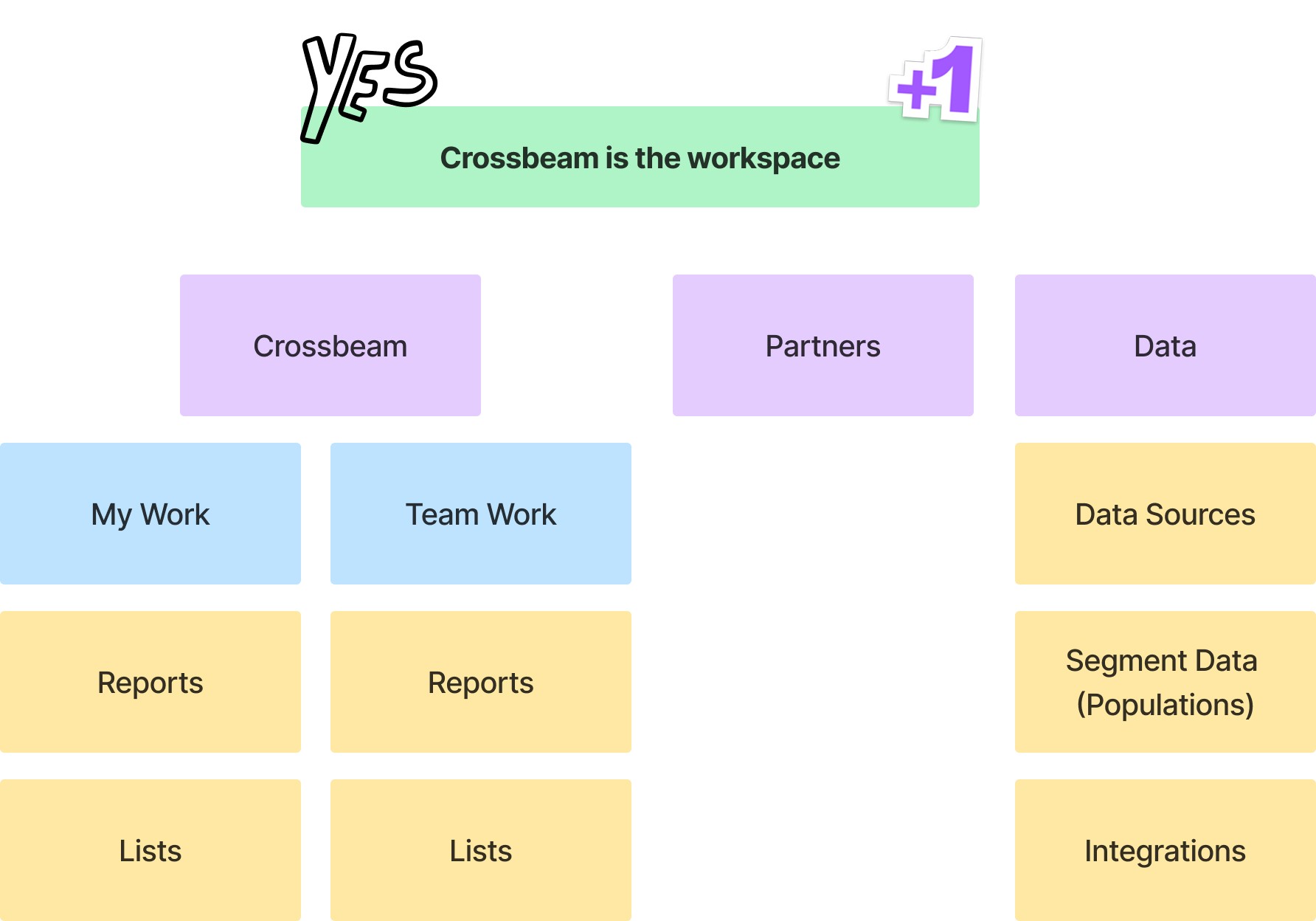
Data Sharing
How do teams and counterparts share data
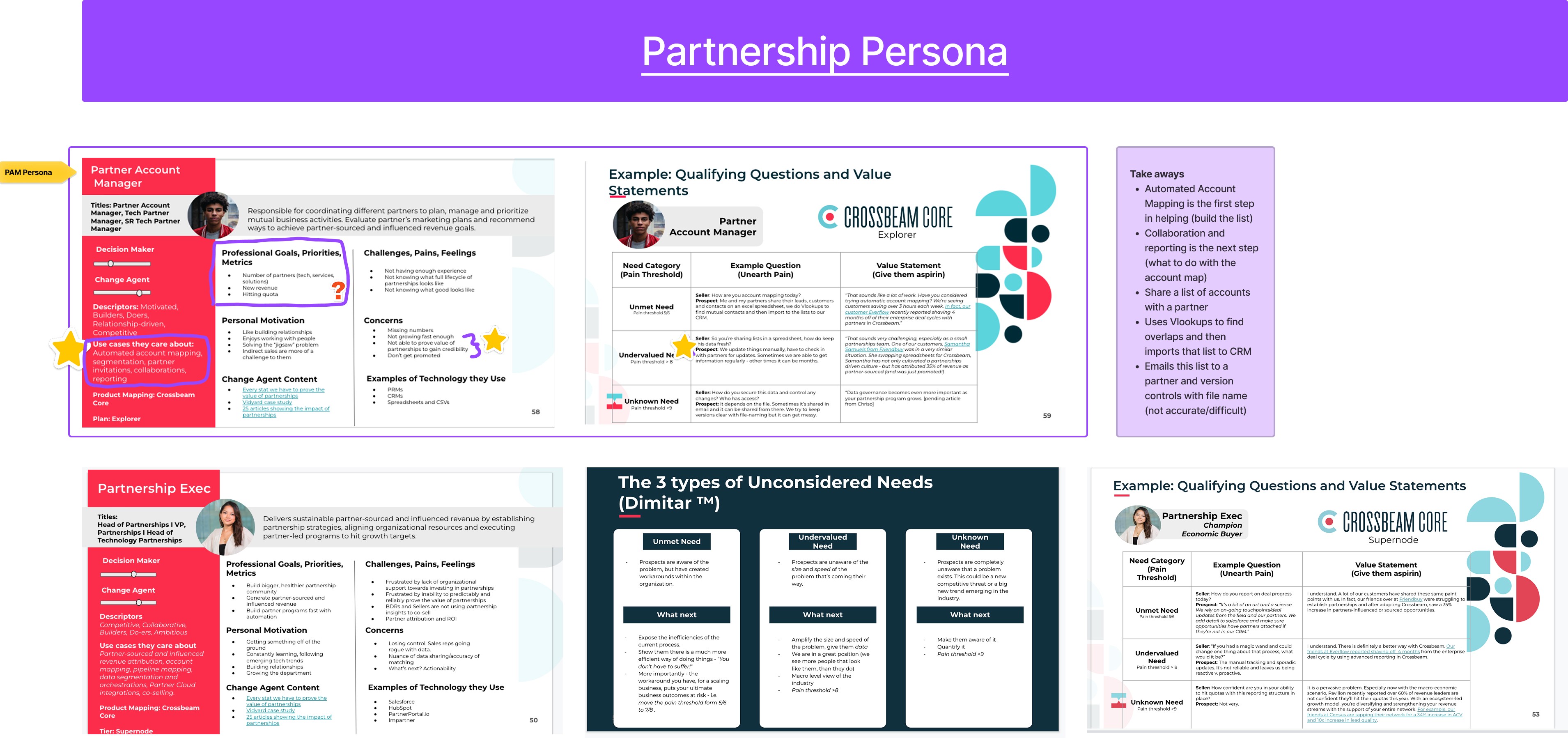
Persona's
Understanding our users and the Partner Account Manager (PAM)
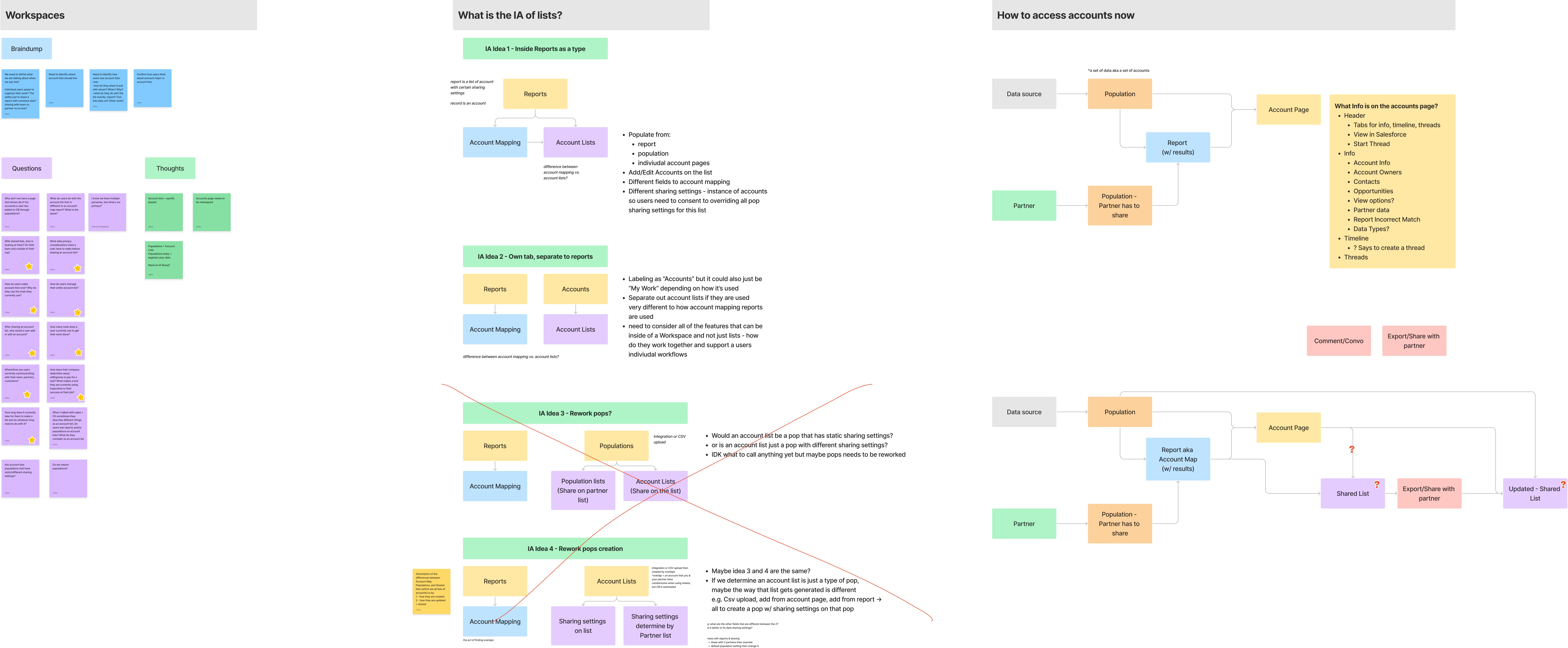
Deep Dive into Workspaces
IA hierarchy, permissions, sharing internal/external
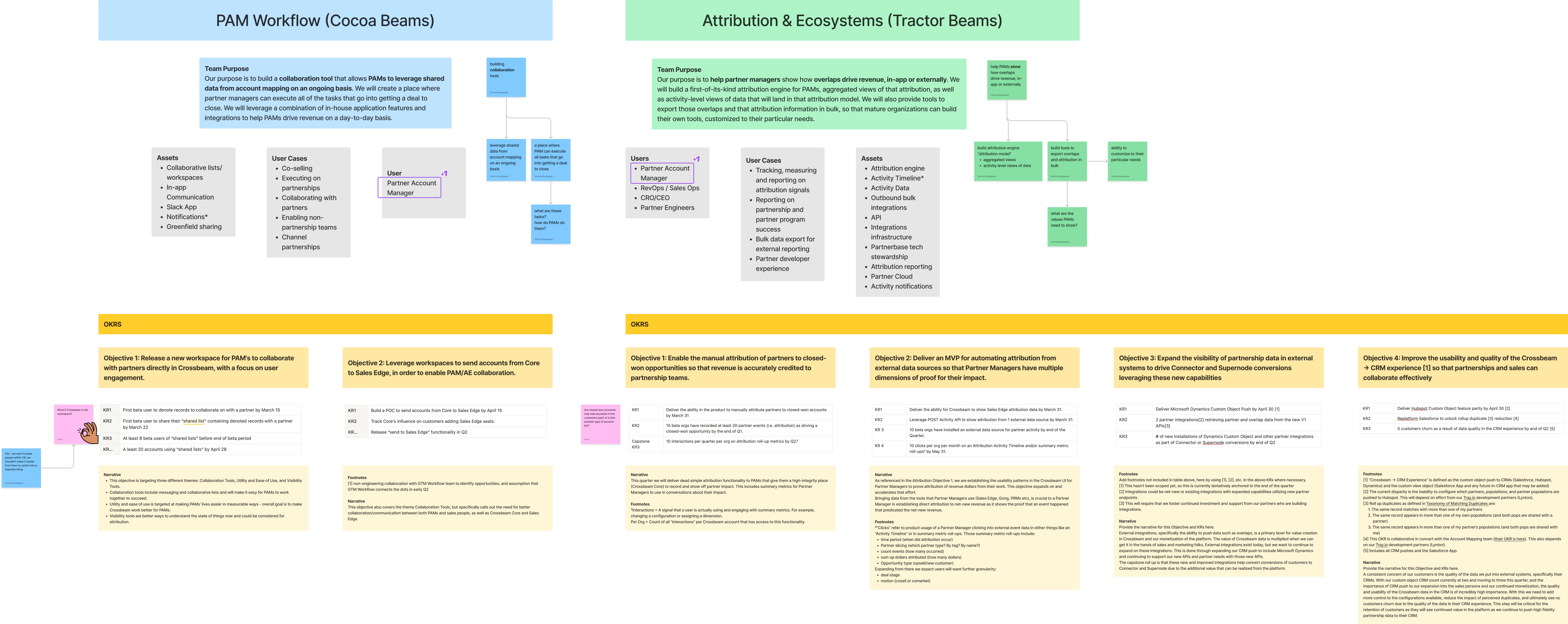
Defining Feature Strategy to OKRs
Ensuring we meet our targets with the proposed designs
17 User Interviews
All customers want shared lists and attribution
They have to account map in Crossbeam first, then export to other tools
Watched one customer show us this process in Lean Data
Collaborating on a list of accounts is usually just a handful
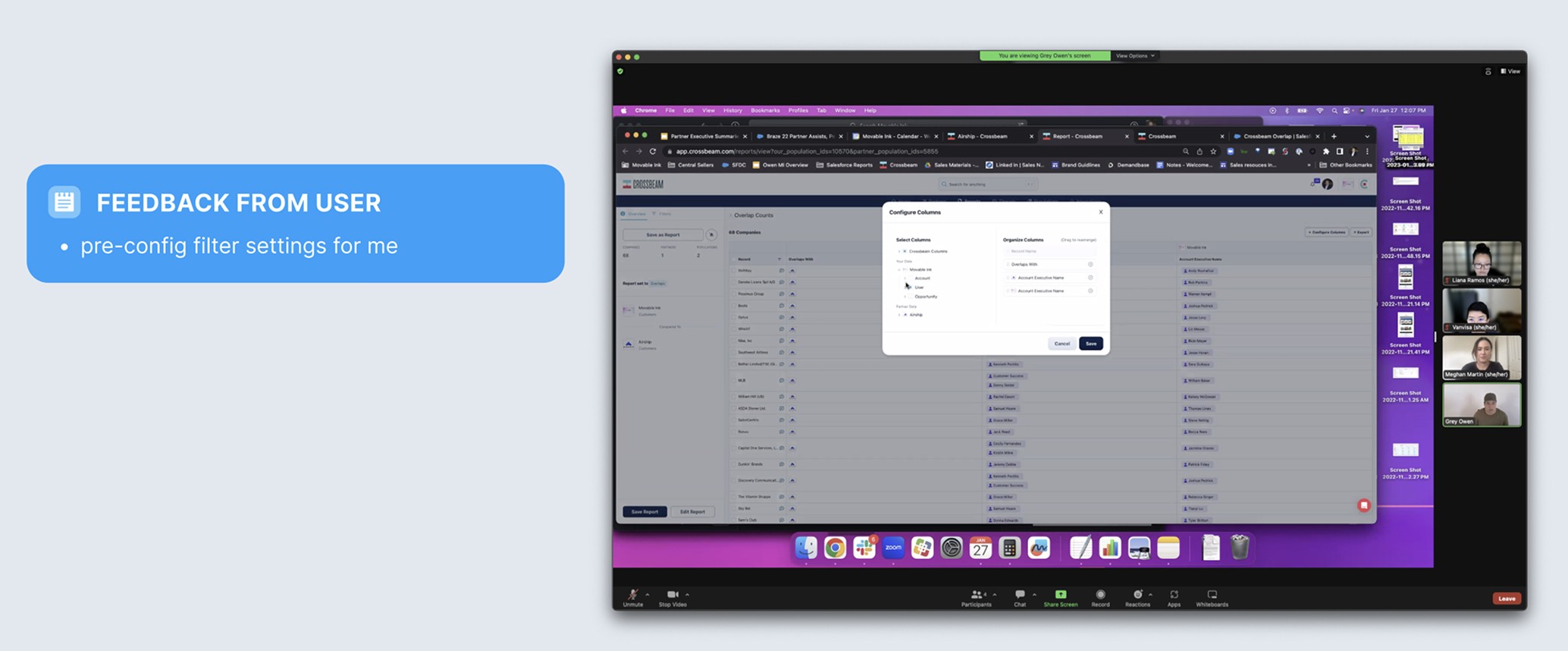
All of The Places Work Get's Done
The inner workings of how accounts are negotiated and deals are made.
Many phone calls, post-its, and CSVs
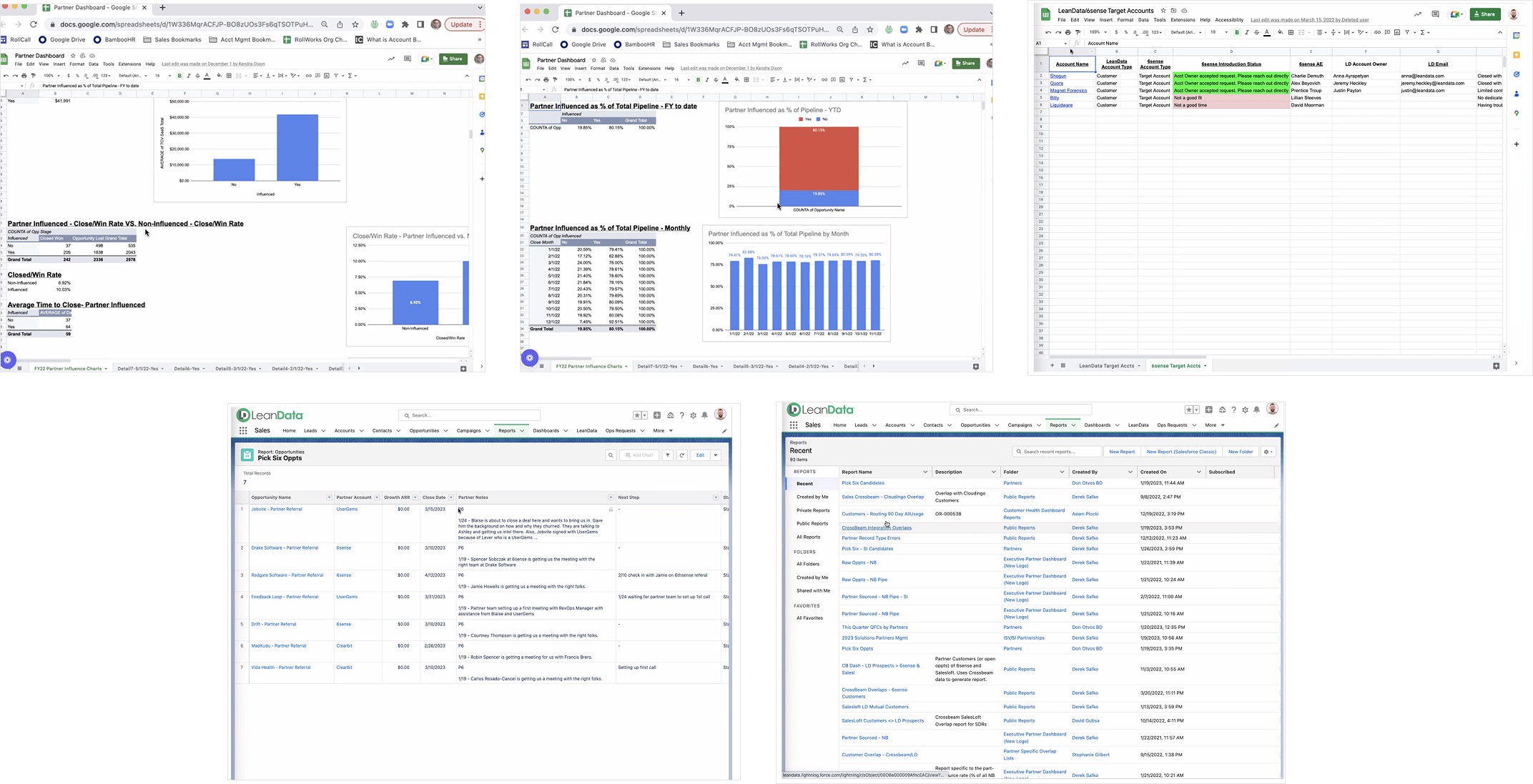
Discovery
17 customer interviews. 6 recorded. Every single customer asked for shared lists and attribution.
The most instructive session was watching a customer walk us through their actual process inside Lean Data, a third-party tool they used to fill the gap Crossbeam had not yet addressed. It showed us both the extent of the workaround and the mental model customers already had for this workflow.
Data Sharing
How do teams and counterparts share data
Persona's
Understanding our users and the Partner Account Manager (PAM)
Deep Dive into Workspaces
IA hierarchy, permissions, sharing internal/external
Defining Feature Strategy to OKRs
Ensuring we meet our targets with the proposed designs
17 User Interviews
All customers want shared lists and attribution
They have to account map in Crossbeam first, then export to other tools
Watched one customer show us this process in Lean Data
Collaborating on a list of accounts is usually just a handful
All of The Places Work Get's Done
The inner workings of how accounts are negotiated and deals are made.
Many phone calls, post-its, and CSVs
Discovery
17 customer interviews. 6 recorded. Every single customer asked for shared lists and attribution.
The most instructive session was watching a customer walk us through their actual process inside Lean Data, a third-party tool they used to fill the gap Crossbeam had not yet addressed. It showed us both the extent of the workaround and the mental model customers already had for this workflow.
Data Sharing
How do teams and counterparts share data
Persona's
Understanding our users and the Partner Account Manager (PAM)
Deep Dive into Workspaces
IA hierarchy, permissions, sharing internal/external
Defining Feature Strategy to OKRs
Ensuring we meet our targets with the proposed designs
17 User Interviews
All customers want shared lists and attribution
They have to account map in Crossbeam first, then export to other tools
Watched one customer show us this process in Lean Data
Collaborating on a list of accounts is usually just a handful
All of The Places Work Get's Done
The inner workings of how accounts are negotiated and deals are made.
Many phone calls, post-its, and CSVs
UXR Takeaways
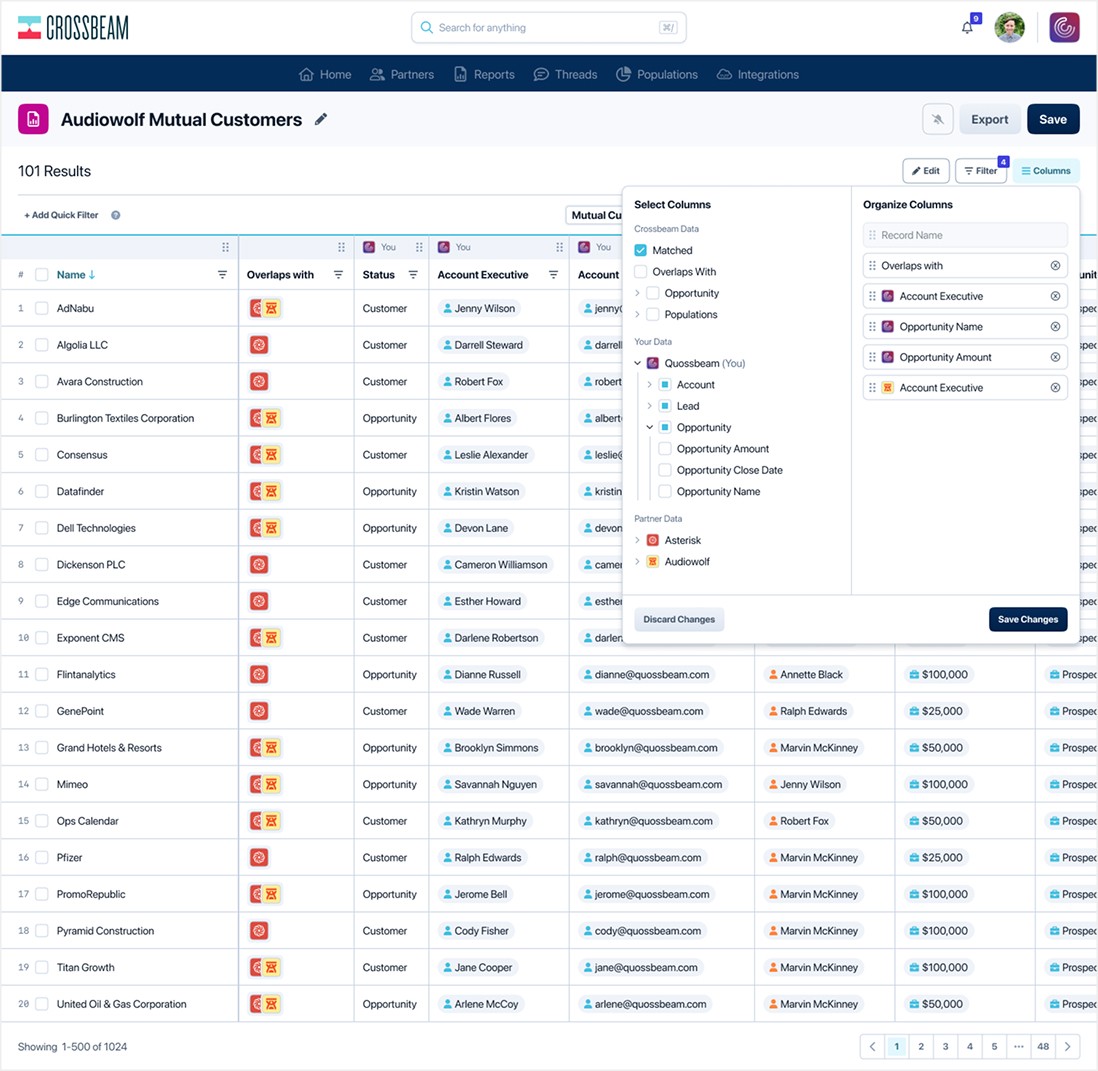
Account mapping may not be where this feature is accessed based on interviews
Lists are short ~6-8 accounts negotiated down to 1-3
Data privacy was tricky with the existing infrastructure so Lists needed to be disparate
Sharing would be a new feature entirely as this does not exist, even within a company
Collaborate on Accounts was not a name our users understand and already called these lists, we would need a new name
We needed to make this as good or better than their current workflow to get our users to adopt this. Exporting/Importing many versions of CSVs has been working for them and they do not
UXR Takeaways
Account mapping may not be where this feature is accessed based on interviews
Lists are short ~6-8 accounts negotiated down to 1-3
Data privacy was tricky with the existing infrastructure so Lists needed to be disparate
Sharing would be a new feature entirely as this does not exist, even within a company
Collaborate on Accounts was not a name our users understand and already called these lists, we would need a new name
We needed to make this as good or better than their current workflow to get our users to adopt this. Exporting/Importing many versions of CSVs has been working for them and they do not
UXR Takeaways
Account mapping may not be where this feature is accessed based on interviews
Lists are short ~6-8 accounts negotiated down to 1-3
Data privacy was tricky with the existing infrastructure so Lists needed to be disparate
Sharing would be a new feature entirely as this does not exist, even within a company
Collaborate on Accounts was not a name our users understand and already called these lists, we would need a new name
We needed to make this as good or better than their current workflow to get our users to adopt this. Exporting/Importing many versions of CSVs has been working for them and they do not
Rethinking The Workflow
We had made assumptions about the PAM workflow like account mapping being the first step. I helped redefine the complete workflow after completing UXR
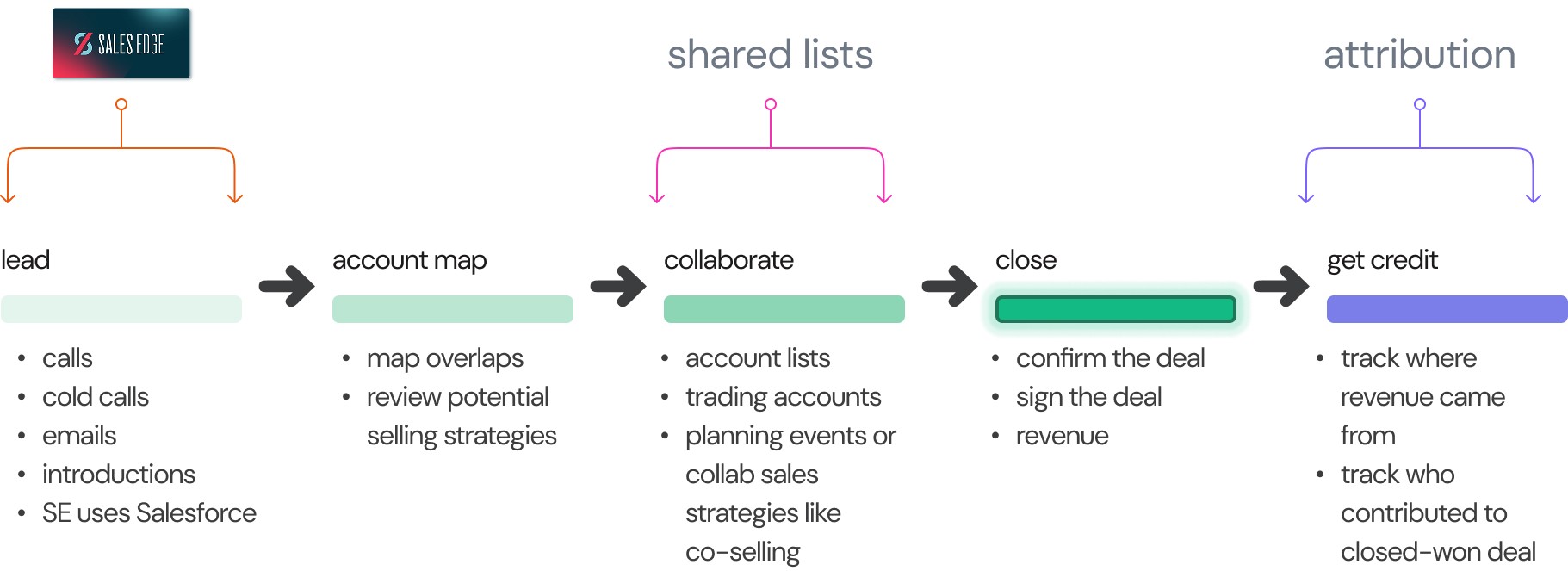
Rethinking The Workflow
We had made assumptions about the PAM workflow like account mapping being the first step. I helped redefine the complete workflow after completing UXR
Rethinking The Workflow
We had made assumptions about the PAM workflow like account mapping being the first step. I helped redefine the complete workflow after completing UXR
The Vision: Near-term Execution, Long-term Intelligence
Capturing the right data early would determine what Crossbeam could learn later.
A shared collaboration and attribution data foundation could meet immediate workflow needs while enabling predictive insights, recommendations, and alerts to help teams close deals faster over time.
The framing that guided every decision: we were not designing two features. We were designing a system that needed to work today and get smarter over time.
Solving the immediate workflow problem, getting PAMs out of spreadsheets and into a real collaboration tool, was necessary. But the more durable opportunity was the data. If Crossbeam could capture which partner actions happened at which stages of a deal, it could eventually surface patterns. Which partners accelerate deal velocity? Which co-selling motions lead to faster closes? What should a PAM do next to move a specific deal forward?
That intelligence was not in scope for this project. But the foundation for it was. And the foundation had to be designed right from the start.
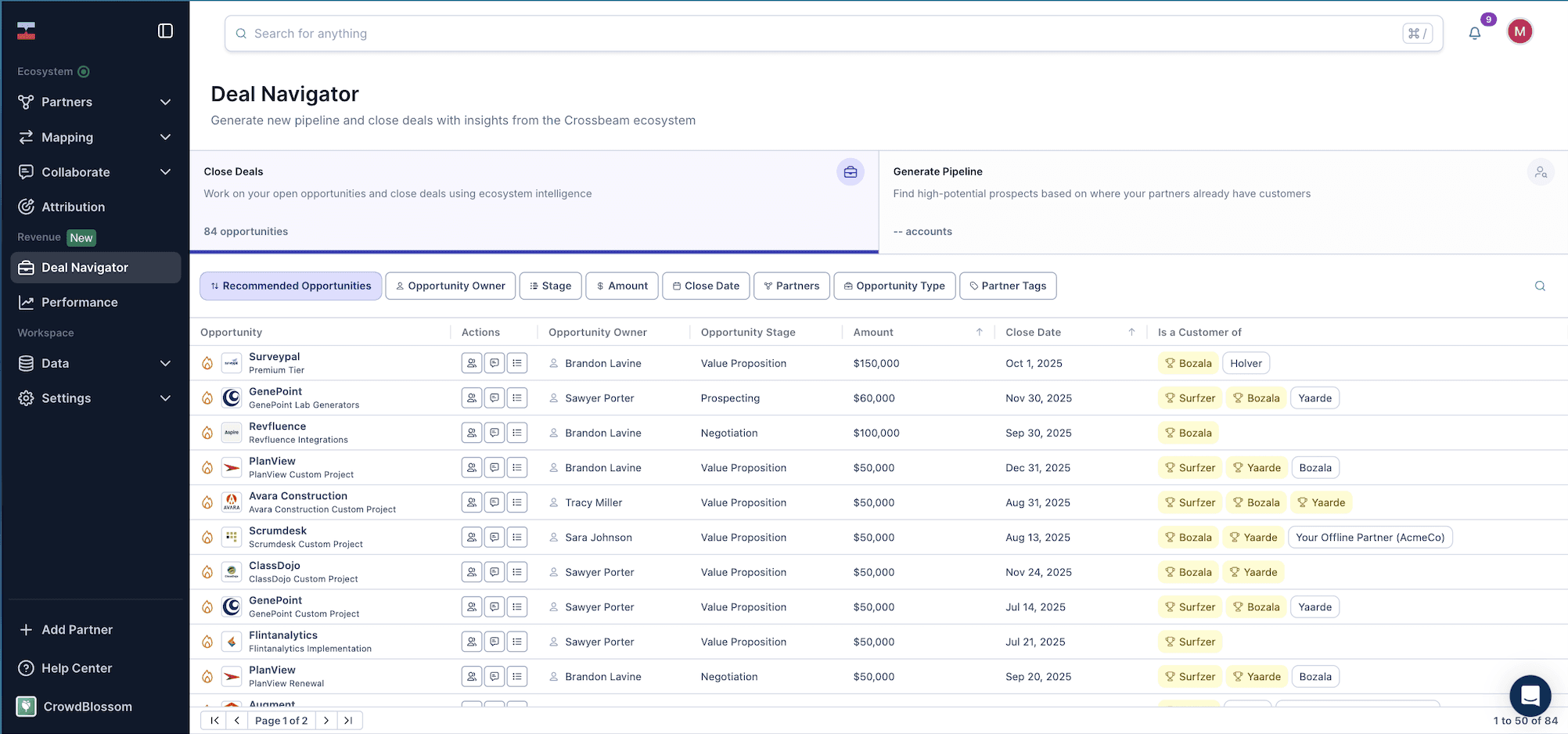
Crossbeam in 2026 showcases their Deal Navigator which is very similar to the vision I set in 2023
The Vision: Near-term Execution, Long-term Intelligence
Capturing the right data early would determine what Crossbeam could learn later.
A shared collaboration and attribution data foundation could meet immediate workflow needs while enabling predictive insights, recommendations, and alerts to help teams close deals faster over time.
The framing that guided every decision: we were not designing two features. We were designing a system that needed to work today and get smarter over time.
Solving the immediate workflow problem, getting PAMs out of spreadsheets and into a real collaboration tool, was necessary. But the more durable opportunity was the data. If Crossbeam could capture which partner actions happened at which stages of a deal, it could eventually surface patterns. Which partners accelerate deal velocity? Which co-selling motions lead to faster closes? What should a PAM do next to move a specific deal forward?
That intelligence was not in scope for this project. But the foundation for it was. And the foundation had to be designed right from the start.
Crossbeam in 2026 showcases their Deal Navigator which is very similar to the vision I set in 2023
The Vision: Near-term Execution, Long-term Intelligence
Capturing the right data early would determine what Crossbeam could learn later.
A shared collaboration and attribution data foundation could meet immediate workflow needs while enabling predictive insights, recommendations, and alerts to help teams close deals faster over time.
The framing that guided every decision: we were not designing two features. We were designing a system that needed to work today and get smarter over time.
Solving the immediate workflow problem, getting PAMs out of spreadsheets and into a real collaboration tool, was necessary. But the more durable opportunity was the data. If Crossbeam could capture which partner actions happened at which stages of a deal, it could eventually surface patterns. Which partners accelerate deal velocity? Which co-selling motions lead to faster closes? What should a PAM do next to move a specific deal forward?
That intelligence was not in scope for this project. But the foundation for it was. And the foundation had to be designed right from the start.
Crossbeam in 2026 showcases their Deal Navigator which is very similar to the vision I set in 2023
Prioritization & Alignment
Discovery showed us our assumptions were not entirely correct and instead of building on top of features we already had, we needed to build new ones
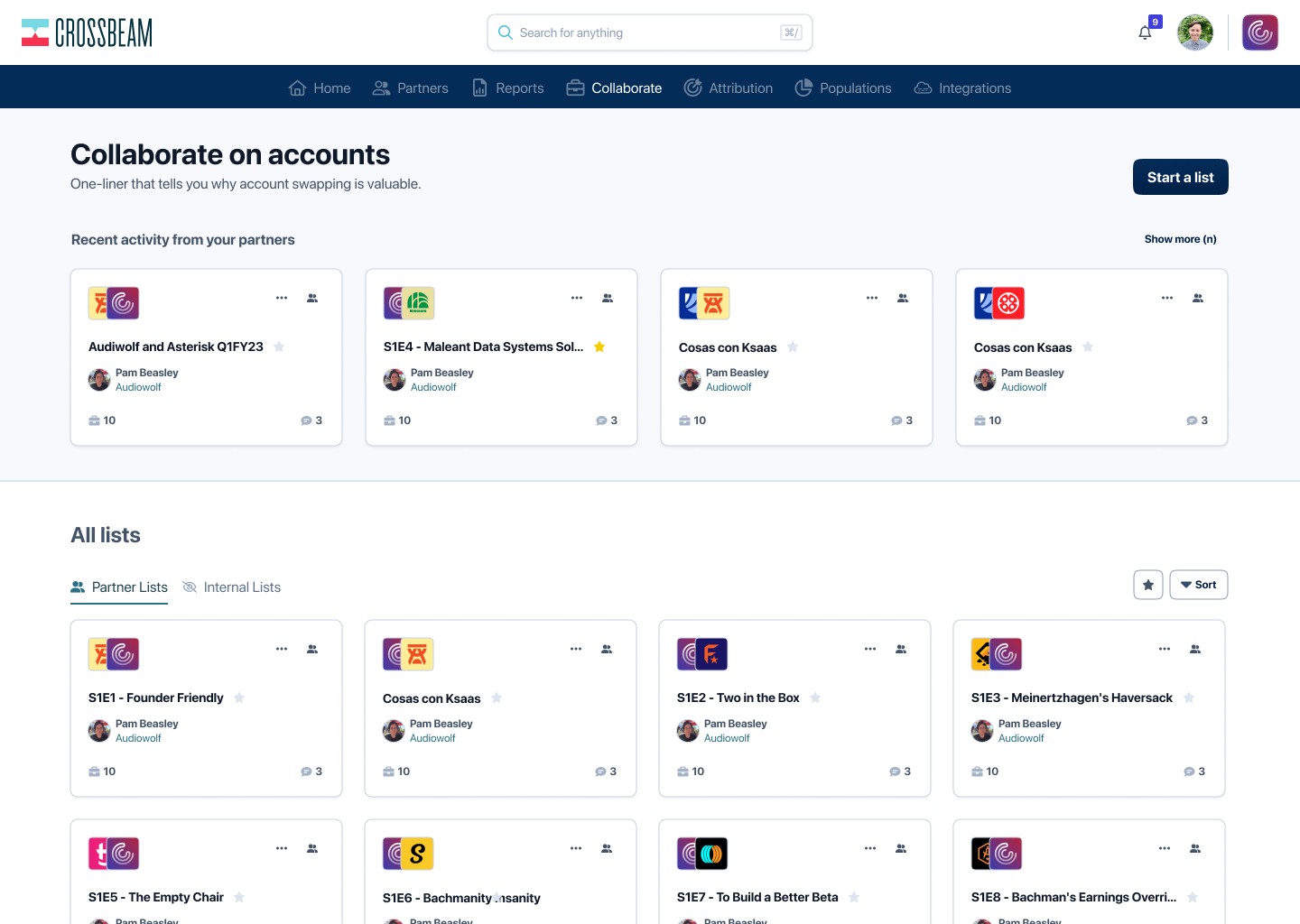
New Page
Shared lists would not be a filter on top of the Account Map report which will require us to build a lot more than we originally assumed
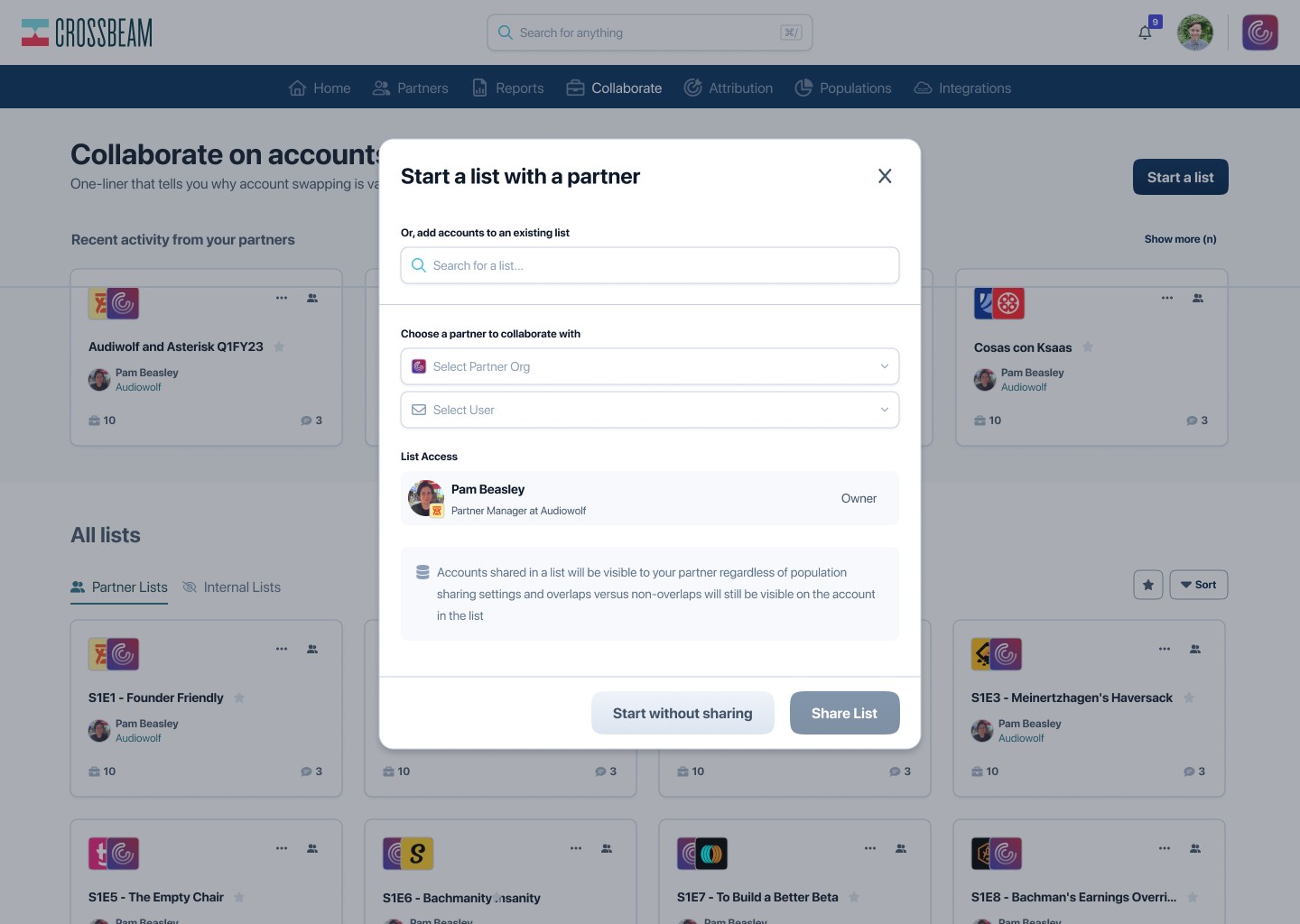
Data Privacy Sharing
Needed to be disparate to existing populations for ease of use and to integrate into the users current workflow more seamlessly
Based on product and engineering needs, feedbacks, and known constraints, we came up with updated requirements
MVP
Create a list from an Account Mapping Report
Create a list from the Collaborate space
Share list with a partner
View my list, view my partners list
Delete List
Add/Delete records
Ability to leave notes on records or messaging feature with partner
Collaborate space for lists
Inbox for recently active lists
Sharing settings agnostic to platform
Nice to Have
messaging/chat feature that could help populate attribution data points
account health
intro status
add custom columns to list
view both partner and my lists together
Add records to list from account page
Collaborate page organization (projects or personal workspaces)
Sharing settings on projects/folders
Surface overlap type on shared list like greenfields
Prioritization & Alignment
Discovery showed us our assumptions were not entirely correct and instead of building on top of features we already had, we needed to build new ones
New Page
Shared lists would not be a filter on top of the Account Map report which will require us to build a lot more than we originally assumed
Data Privacy Sharing
Needed to be disparate to existing populations for ease of use and to integrate into the users current workflow more seamlessly
Based on product and engineering needs, feedbacks, and known constraints, we came up with updated requirements
MVP
Create a list from an Account Mapping Report
Create a list from the Collaborate space
Share list with a partner
View my list, view my partners list
Delete List
Add/Delete records
Ability to leave notes on records or messaging feature with partner
Collaborate space for lists
Inbox for recently active lists
Sharing settings agnostic to platform
Nice to Have
messaging/chat feature that could help populate attribution data points
account health
intro status
add custom columns to list
view both partner and my lists together
Add records to list from account page
Collaborate page organization (projects or personal workspaces)
Sharing settings on projects/folders
Surface overlap type on shared list like greenfields
Prioritization & Alignment
Discovery showed us our assumptions were not entirely correct and instead of building on top of features we already had, we needed to build new ones
New Page
Shared lists would not be a filter on top of the Account Map report which will require us to build a lot more than we originally assumed
Data Privacy Sharing
Needed to be disparate to existing populations for ease of use and to integrate into the users current workflow more seamlessly
Based on product and engineering needs, feedbacks, and known constraints, we came up with updated requirements
MVP
Create a list from an Account Mapping Report
Create a list from the Collaborate space
Share list with a partner
View my list, view my partners list
Delete List
Add/Delete records
Ability to leave notes on records or messaging feature with partner
Collaborate space for lists
Inbox for recently active lists
Sharing settings agnostic to platform
Nice to Have
messaging/chat feature that could help populate attribution data points
account health
intro status
add custom columns to list
view both partner and my lists together
Add records to list from account page
Collaborate page organization (projects or personal workspaces)
Sharing settings on projects/folders
Surface overlap type on shared list like greenfields
Phased Development
M1 gets us to Beta on time while we test new features, build new components.
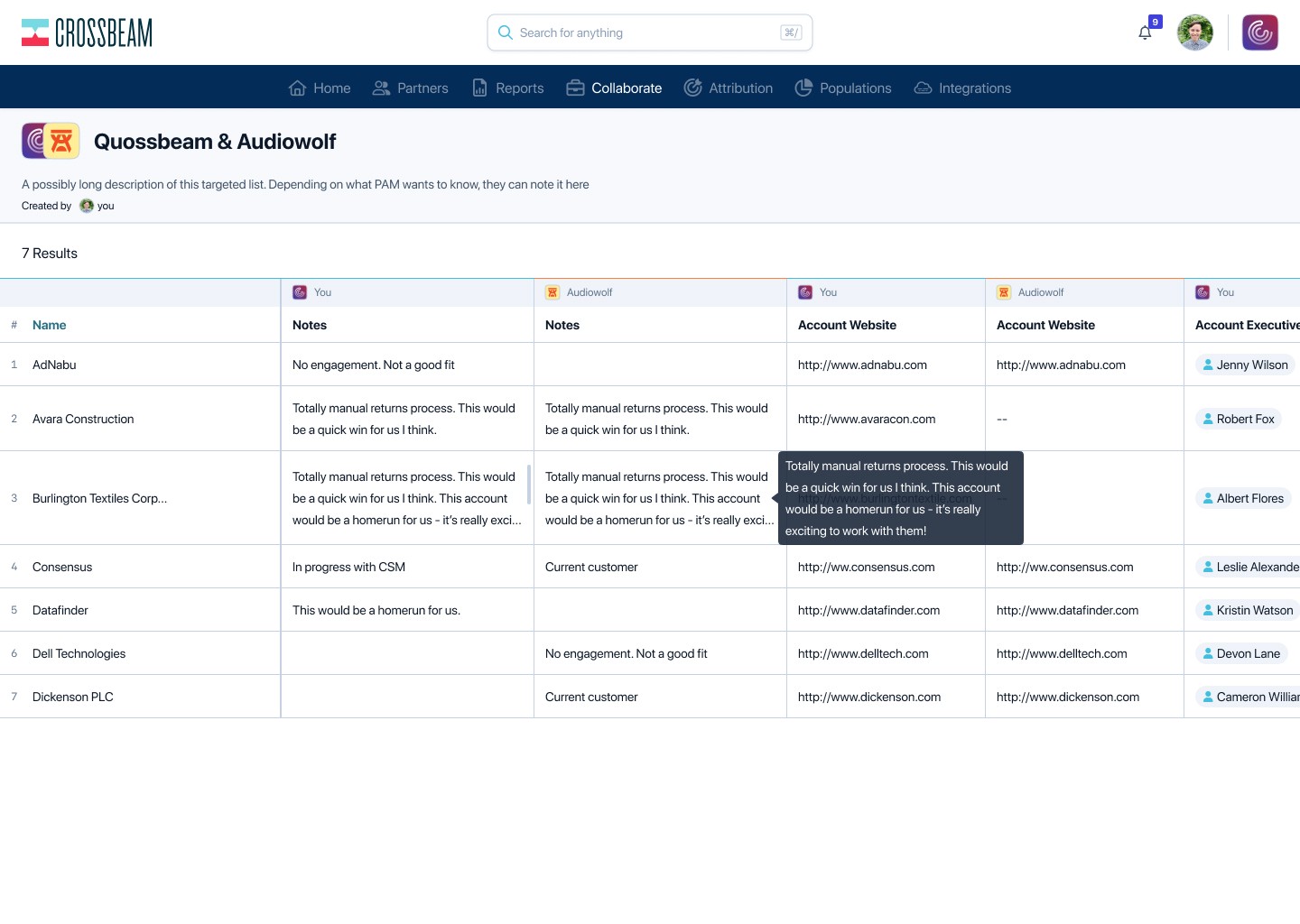
M1
Lists could not be edited, filtered, shared
M2
Lists could be edited, filtered, shared
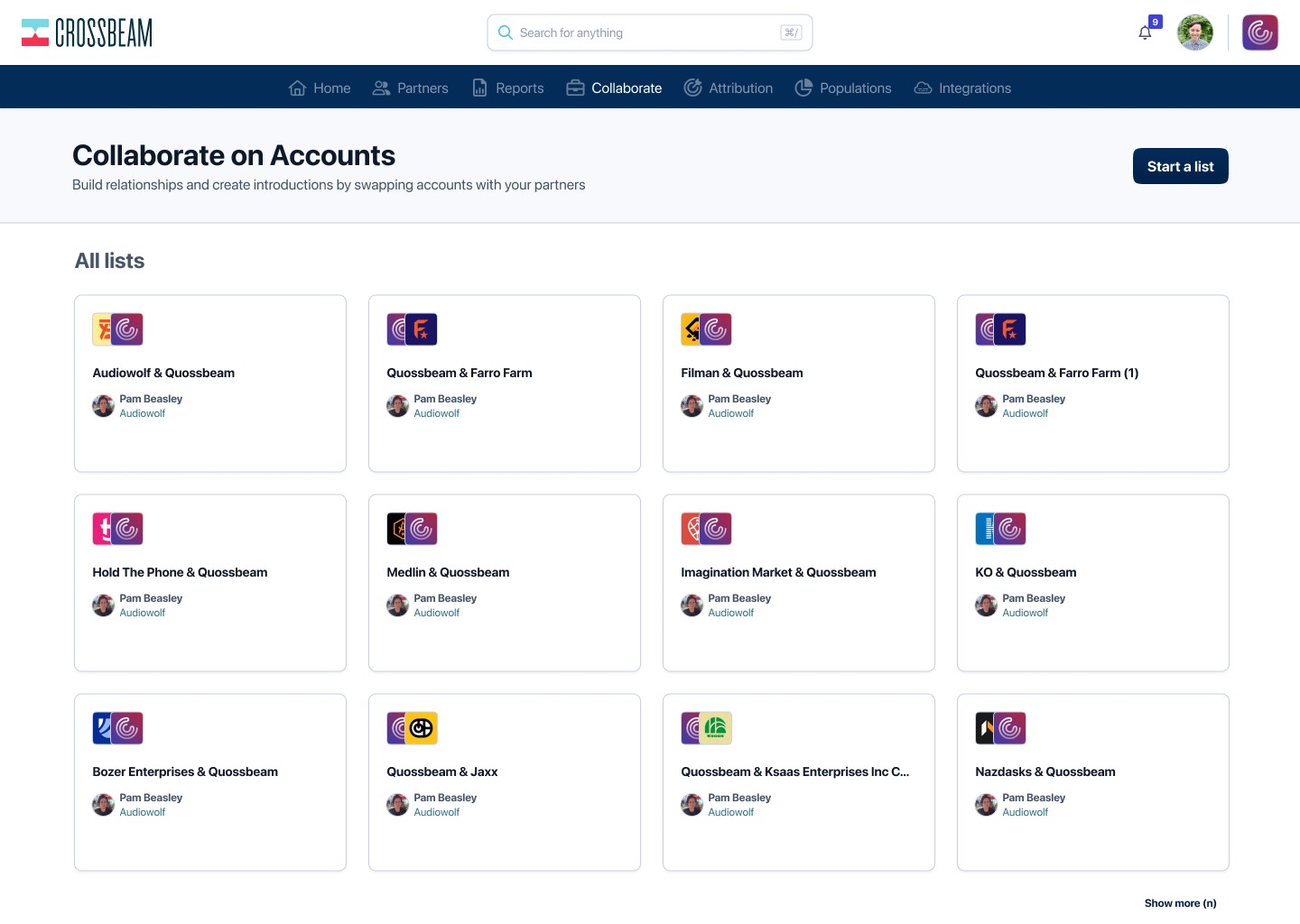
M1
Lists could not be edited, shared, or deleted
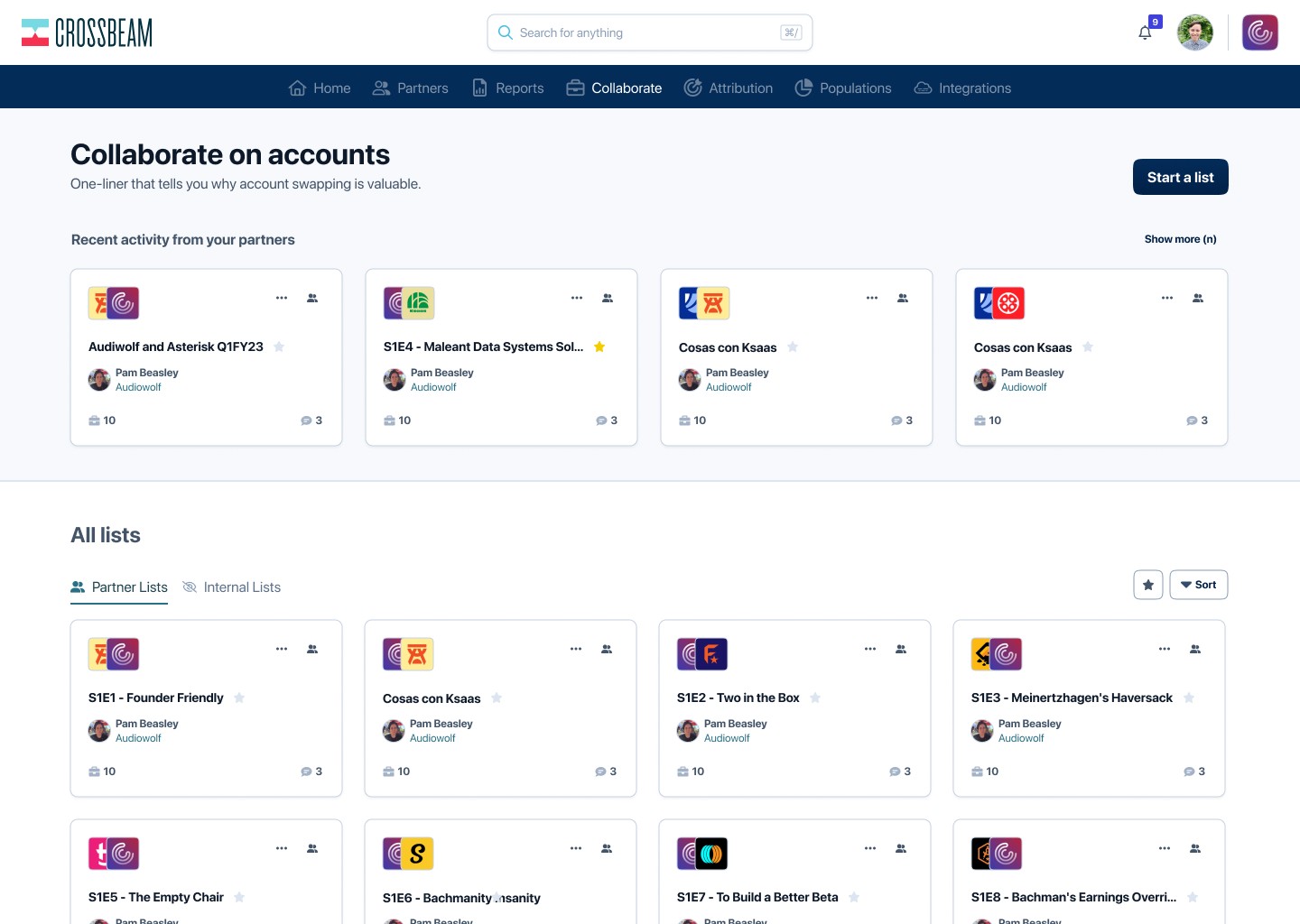
M2
Lists could be edited, shared, deleted, recent lists shown at top
Phased Development
M1 gets us to Beta on time while we test new features, build new components.
M1
Lists could not be edited, filtered, shared
M2
Lists could be edited, filtered, shared
M1
Lists could not be edited, shared, or deleted
M2
Lists could be edited, shared, deleted, recent lists shown at top
Phased Development
M1 gets us to Beta on time while we test new features, build new components.
M1
Lists could not be edited, filtered, shared
M2
Lists could be edited, filtered, shared
M1
Lists could not be edited, shared, or deleted
M2
Lists could be edited, shared, deleted, recent lists shown at top
Market Research & Early Explorations
Now that we had a clear direction, I looked at how other products quickly added items to lists and workspace management
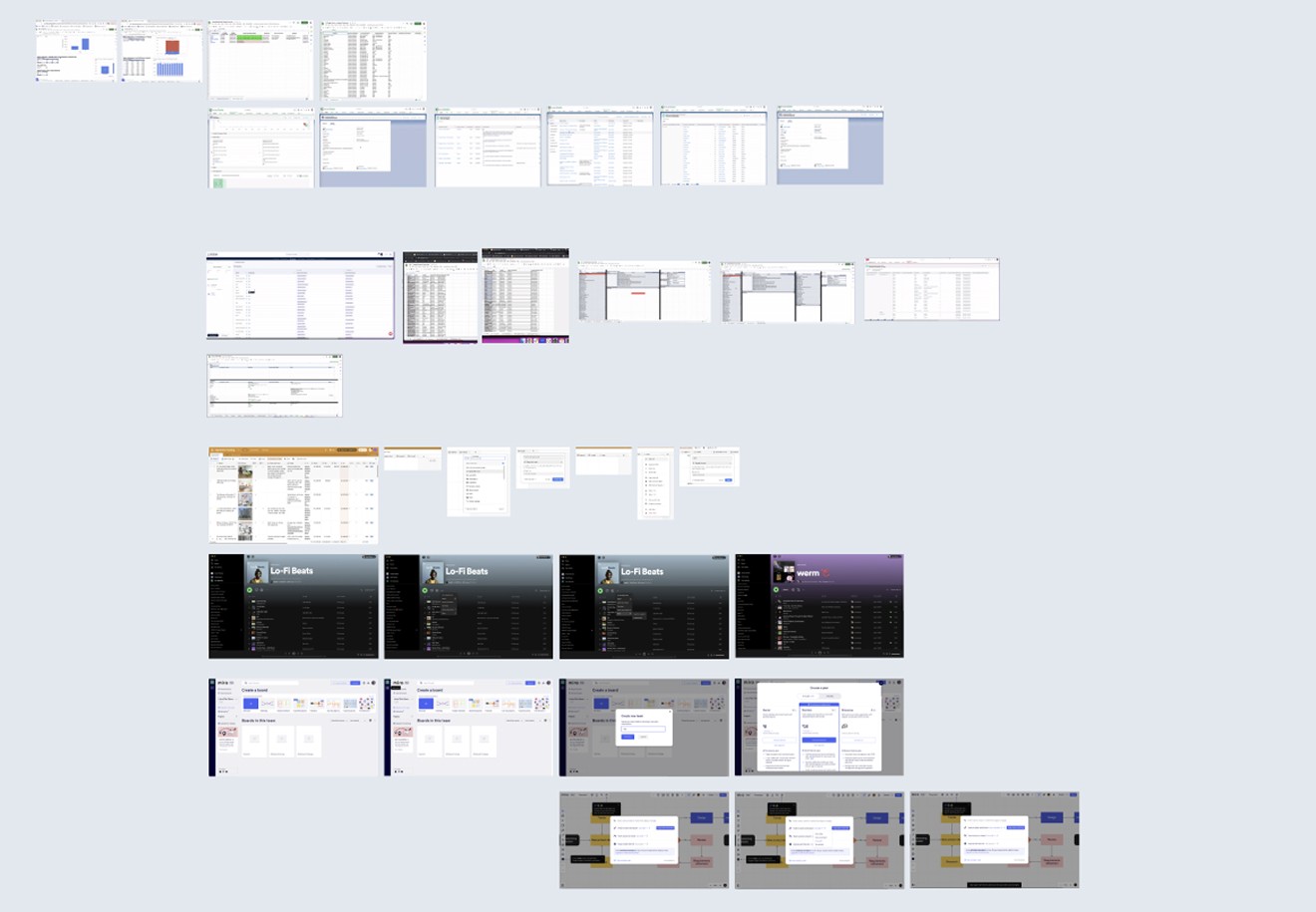
Add to Lists
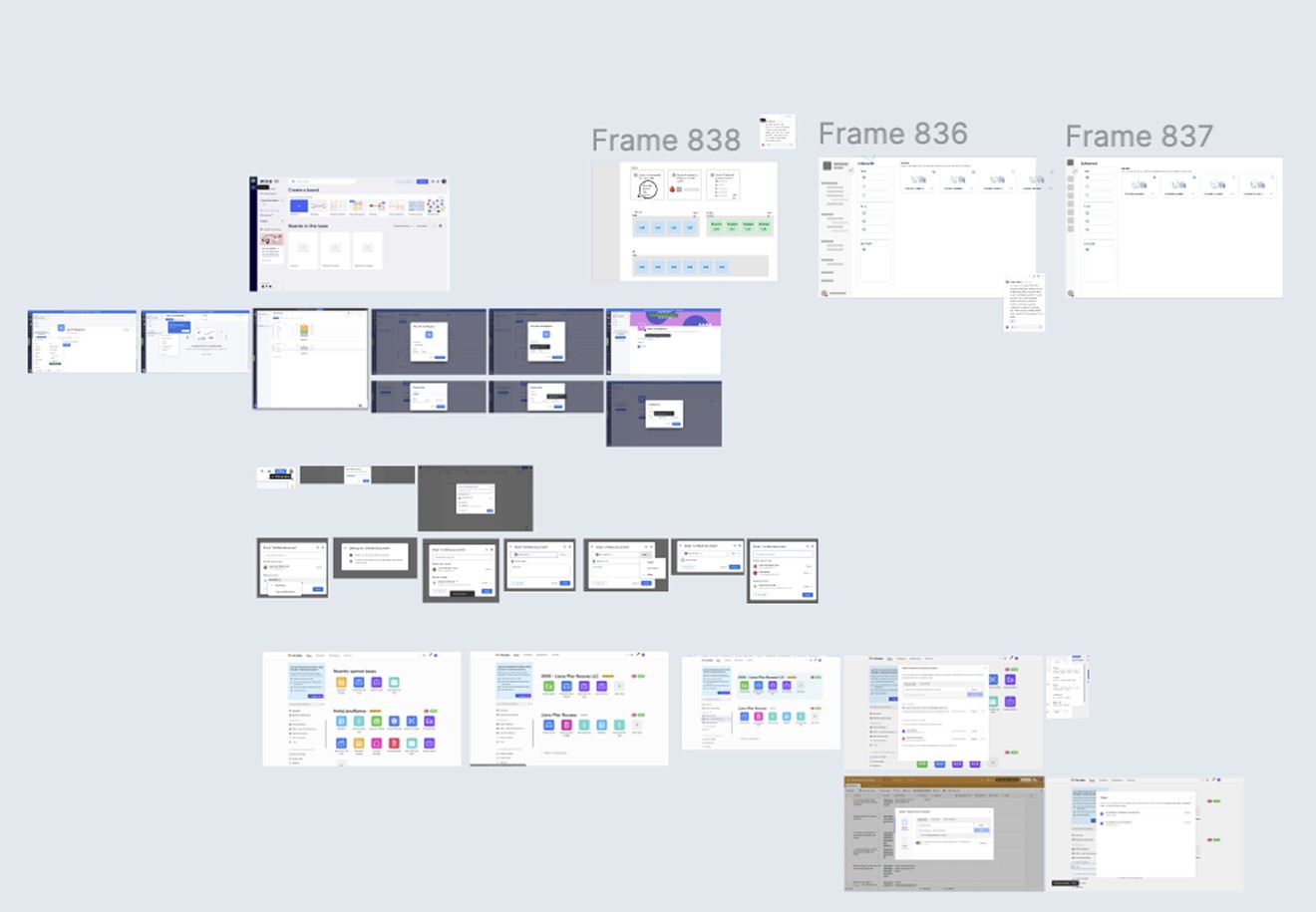
Managing Lists
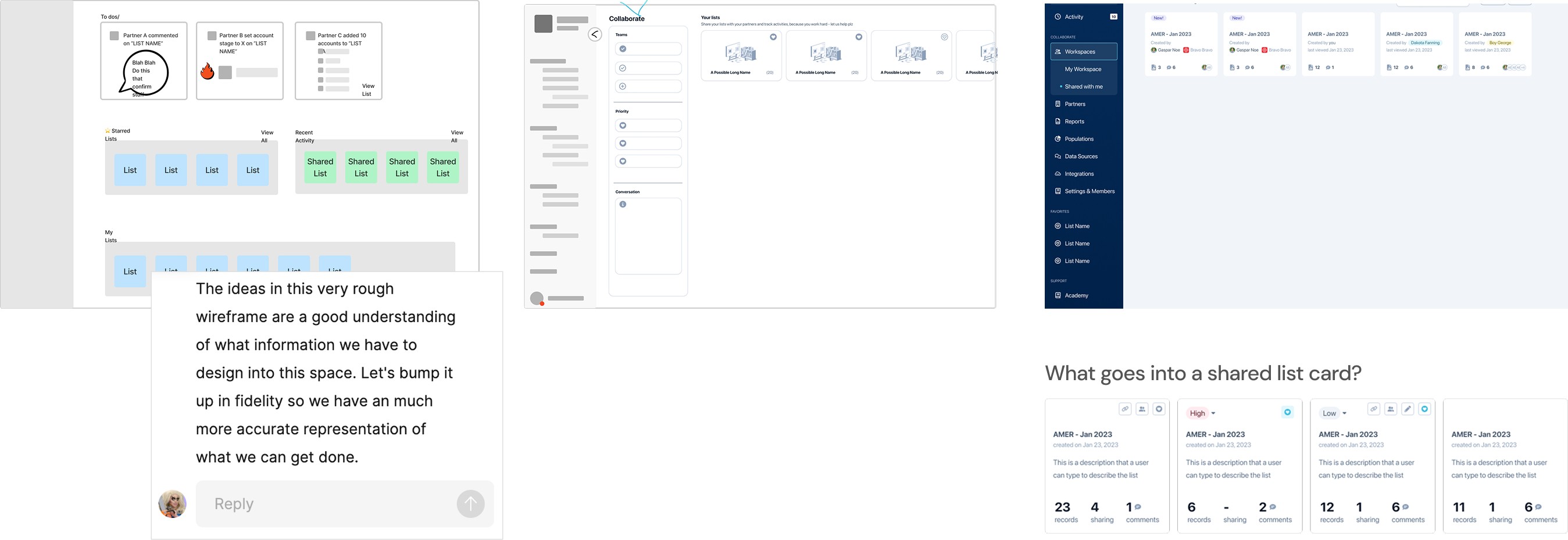
Very low-fi Wireframes
Market Research & Early Explorations
Now that we had a clear direction, I looked at how other products quickly added items to lists and workspace management
Add to Lists
Managing Lists
Very low-fi Wireframes
Market Research & Early Explorations
Now that we had a clear direction, I looked at how other products quickly added items to lists and workspace management
Add to Lists
Managing Lists
Very low-fi Wireframes
Scaling the product required scaling the system behind it
Scaling the product required scaling the system behind it
Scaling the product required scaling the system behind it
Vertical Navigation
As Shared Lists and Attribution were being designed, it became clear the existing horizontal navigation would not scale. Adding two new product areas to a horizontal nav was already pushing it.
I made the case for a vertical navigation model, designed it alongside the feature work, and it shipped in Q2 2023. It was adopted across the product.
This was not in scope and faced a lot of resistance at first. While building for beta, it became clear to the teams that these new features would not be easily accessed or showcased and there will be more rework later. We built our mvp beta features using the horizontal navigation and fast followed the vertical navigation after some user testing.
Existing Horizontal Nav
Vertical Concept Nav
Vertical Navigation
As Shared Lists and Attribution were being designed, it became clear the existing horizontal navigation would not scale. Adding two new product areas to a horizontal nav was already pushing it.
I made the case for a vertical navigation model, designed it alongside the feature work, and it shipped in Q2 2023. It was adopted across the product.
This was not in scope and faced a lot of resistance at first. While building for beta, it became clear to the teams that these new features would not be easily accessed or showcased and there will be more rework later. We built our mvp beta features using the horizontal navigation and fast followed the vertical navigation after some user testing.
Existing Horizontal Nav
Vertical Concept Nav
Vertical Navigation
As Shared Lists and Attribution were being designed, it became clear the existing horizontal navigation would not scale. Adding two new product areas to a horizontal nav was already pushing it.
I made the case for a vertical navigation model, designed it alongside the feature work, and it shipped in Q2 2023. It was adopted across the product.
This was not in scope and faced a lot of resistance at first. While building for beta, it became clear to the teams that these new features would not be easily accessed or showcased and there will be more rework later. We built our mvp beta features using the horizontal navigation and fast followed the vertical navigation after some user testing.
Existing Horizontal Nav
Vertical Concept Nav
In 8 weeks, Crossbeam evolved from a point solution into a workflow-driven platform
In 8 weeks, Crossbeam evolved from a point solution into a workflow-driven platform
In 8 weeks, Crossbeam evolved from a point solution into a workflow-driven platform
Designs
Shared List
Start a List from Account Map
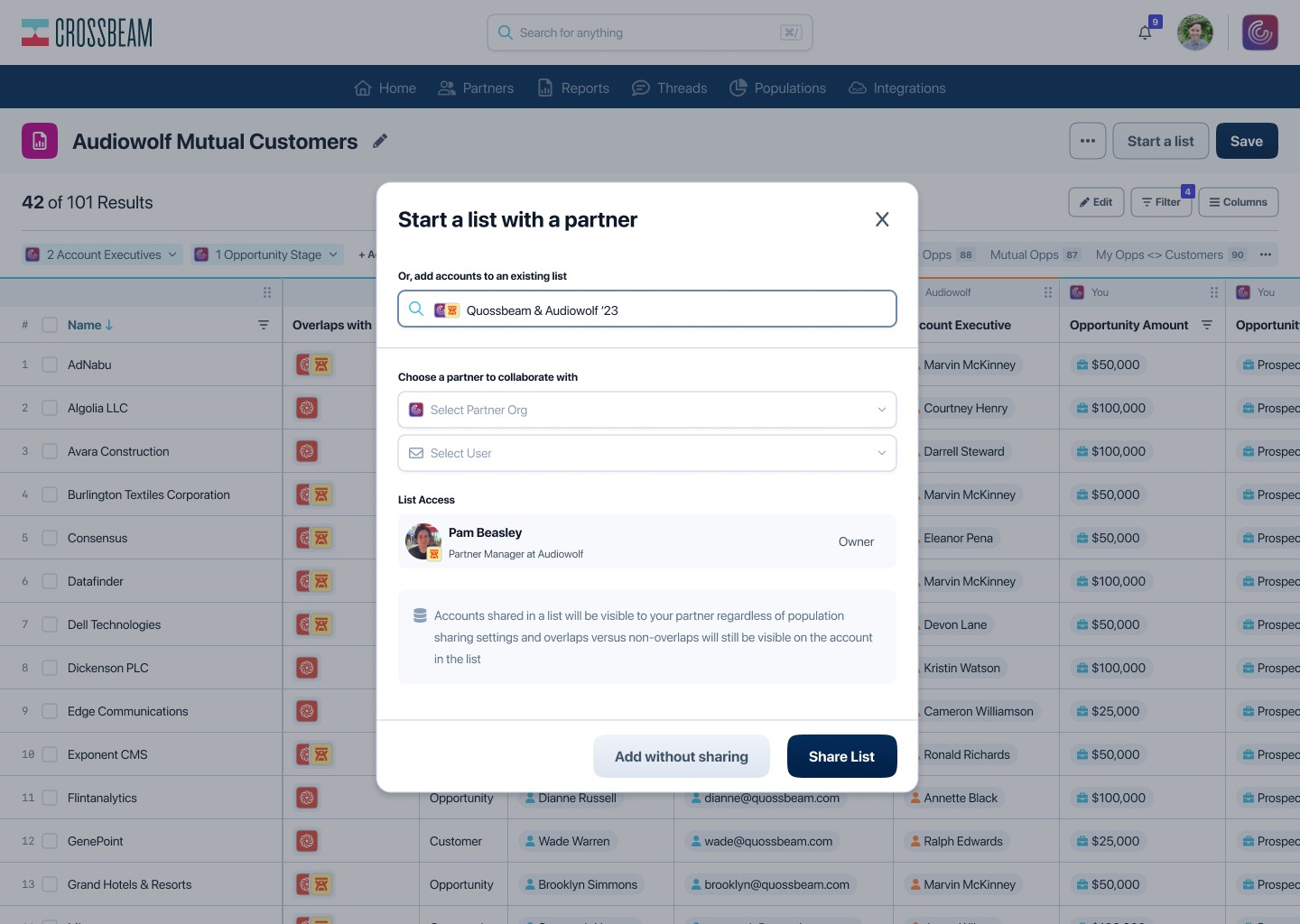
Start a List from the Collaborate Page
Add Accounts to List
Modeled after Spotify
Receiving a List
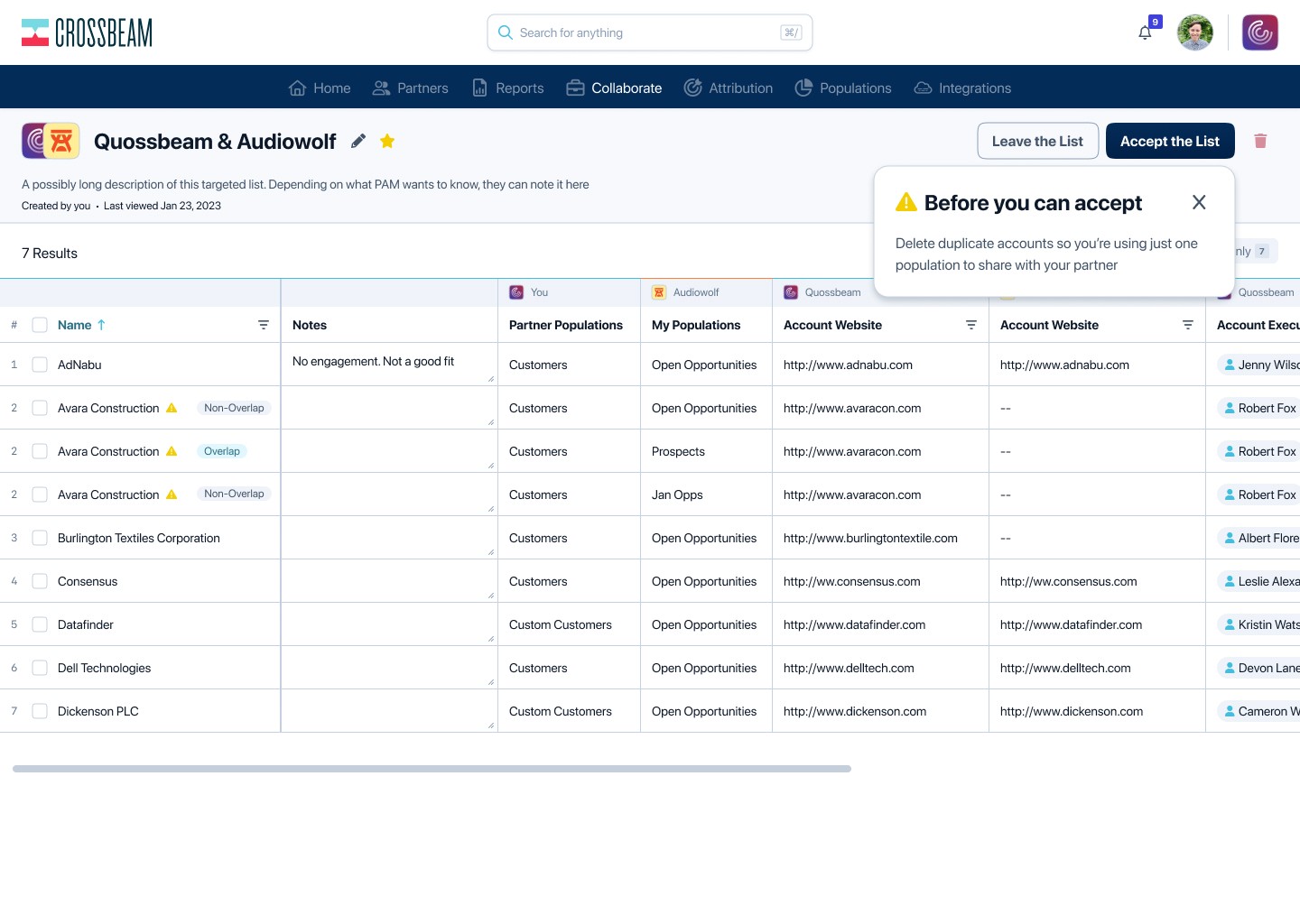
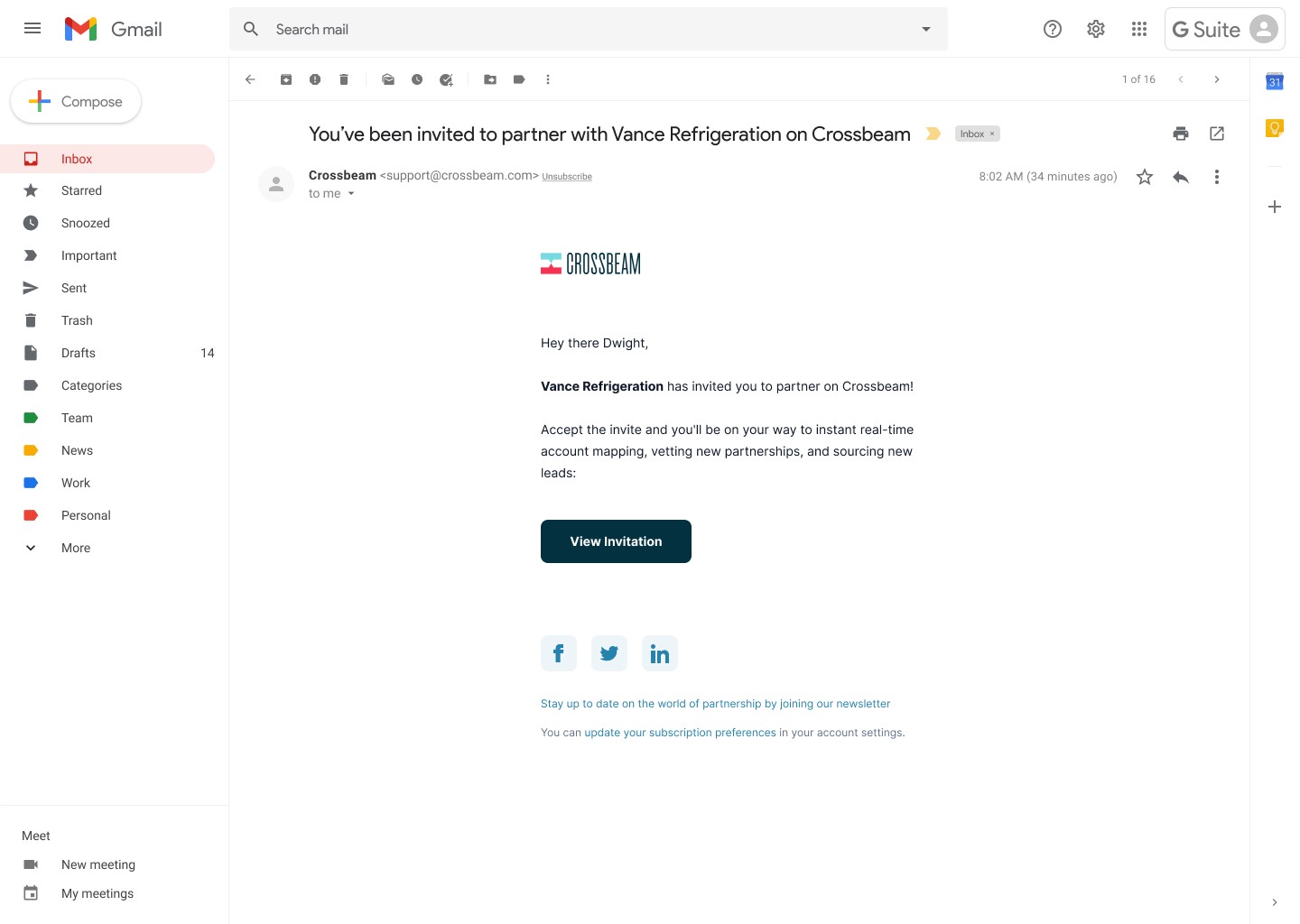
Designs
Shared List
Start a List from Account Map
Start a List from the Collaborate Page
Add Accounts to List
Modeled after Spotify
Receiving a List
Designs
Shared List
Start a List from Account Map
Start a List from the Collaborate Page
Add Accounts to List
Modeled after Spotify
Receiving a List
Curve ball
SalesEdge was built to integrate with Salesforce. We were still building our Salesforce integration at the time.
Challenges
Unable to link the SE work to attribution which means manual inputs
Issues with object mapping due to duplicate data, incorrect or invalid field selections of parent to child fields, general data hygiene
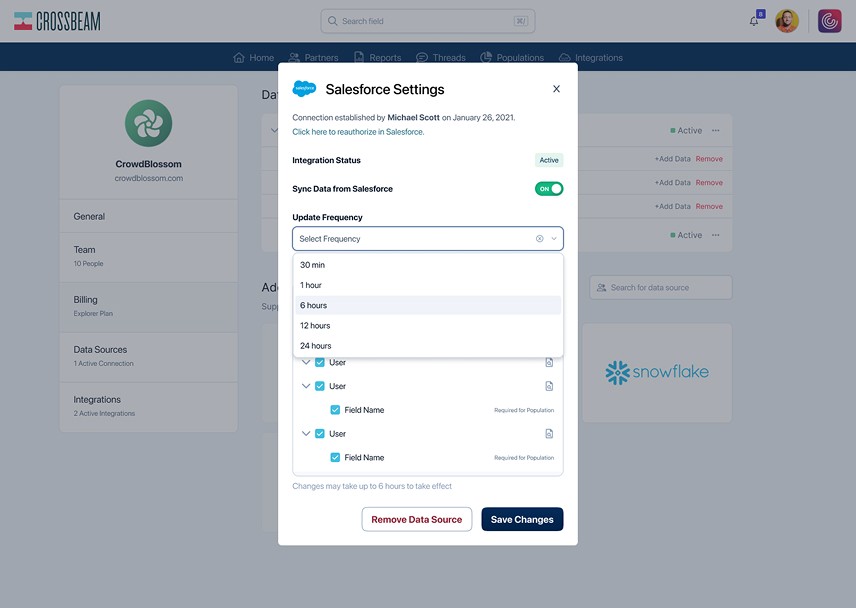
Solution
Make manual inputs easier with copying shortcuts or pre-loading lists
Incorporate SE needs to existing SF project and speed up timeline
Data templating and integration set up guides
Duplicate fields identification and reviews
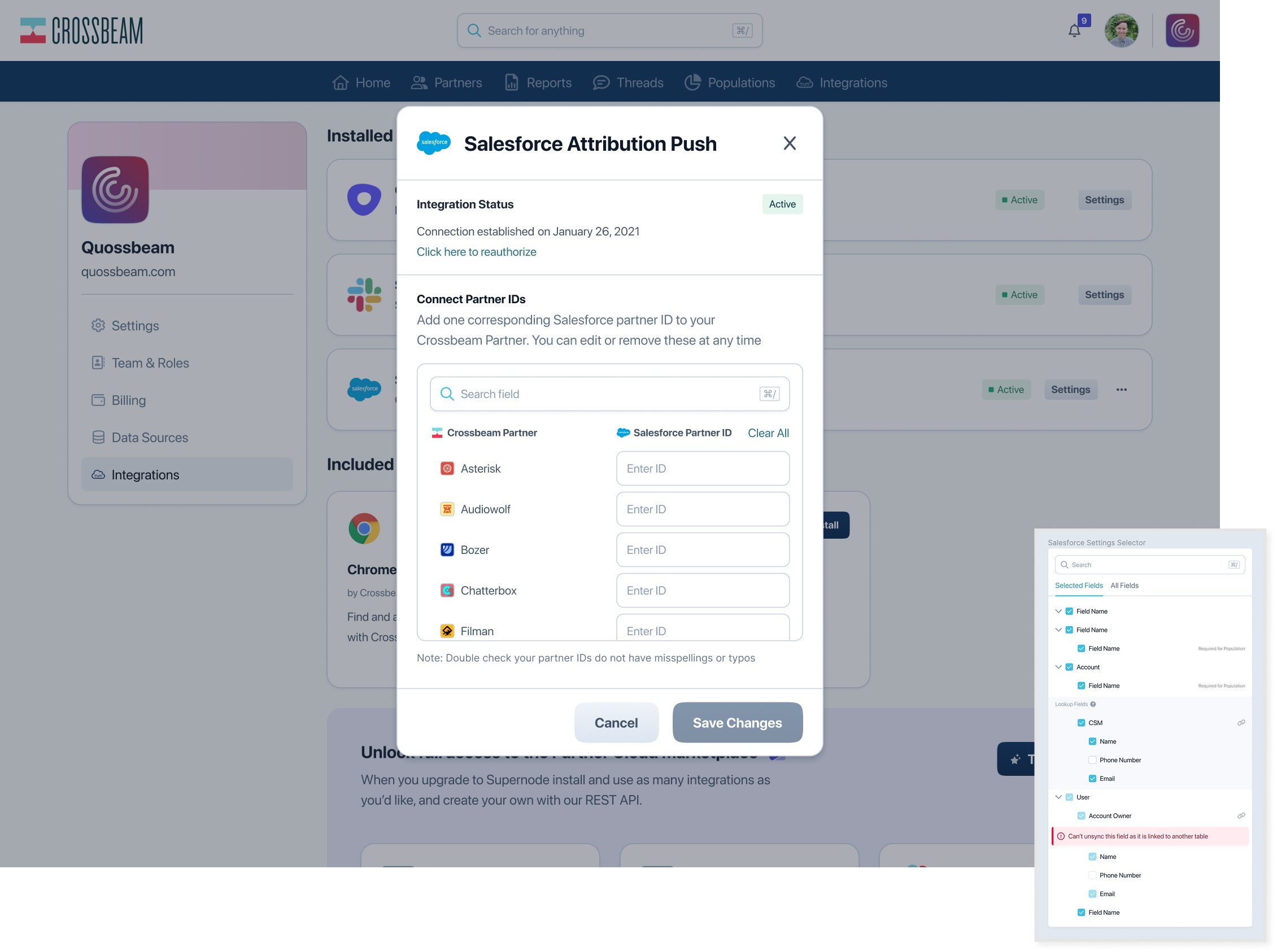
Curve ball
SalesEdge was built to integrate with Salesforce. We were still building our Salesforce integration at the time.
Challenges
Unable to link the SE work to attribution which means manual inputs
Issues with object mapping due to duplicate data, incorrect or invalid field selections of parent to child fields, general data hygiene
Solution
Make manual inputs easier with copying shortcuts or pre-loading lists
Incorporate SE needs to existing SF project and speed up timeline
Data templating and integration set up guides
Duplicate fields identification and reviews
Curve ball
SalesEdge was built to integrate with Salesforce. We were still building our Salesforce integration at the time.
Challenges
Unable to link the SE work to attribution which means manual inputs
Issues with object mapping due to duplicate data, incorrect or invalid field selections of parent to child fields, general data hygiene
Solution
Make manual inputs easier with copying shortcuts or pre-loading lists
Incorporate SE needs to existing SF project and speed up timeline
Data templating and integration set up guides
Duplicate fields identification and reviews
Designs
Attribution
Salesforce Push
Designs
Attribution
Salesforce Push
Designs
Attribution
Salesforce Push
New navigation launched Q2
Live products launched in Q3-Q4
New navigation launched Q2
Live products launched in Q3-Q4
New navigation launched Q2
Live products launched in Q3-Q4
Live Products & Testimonials
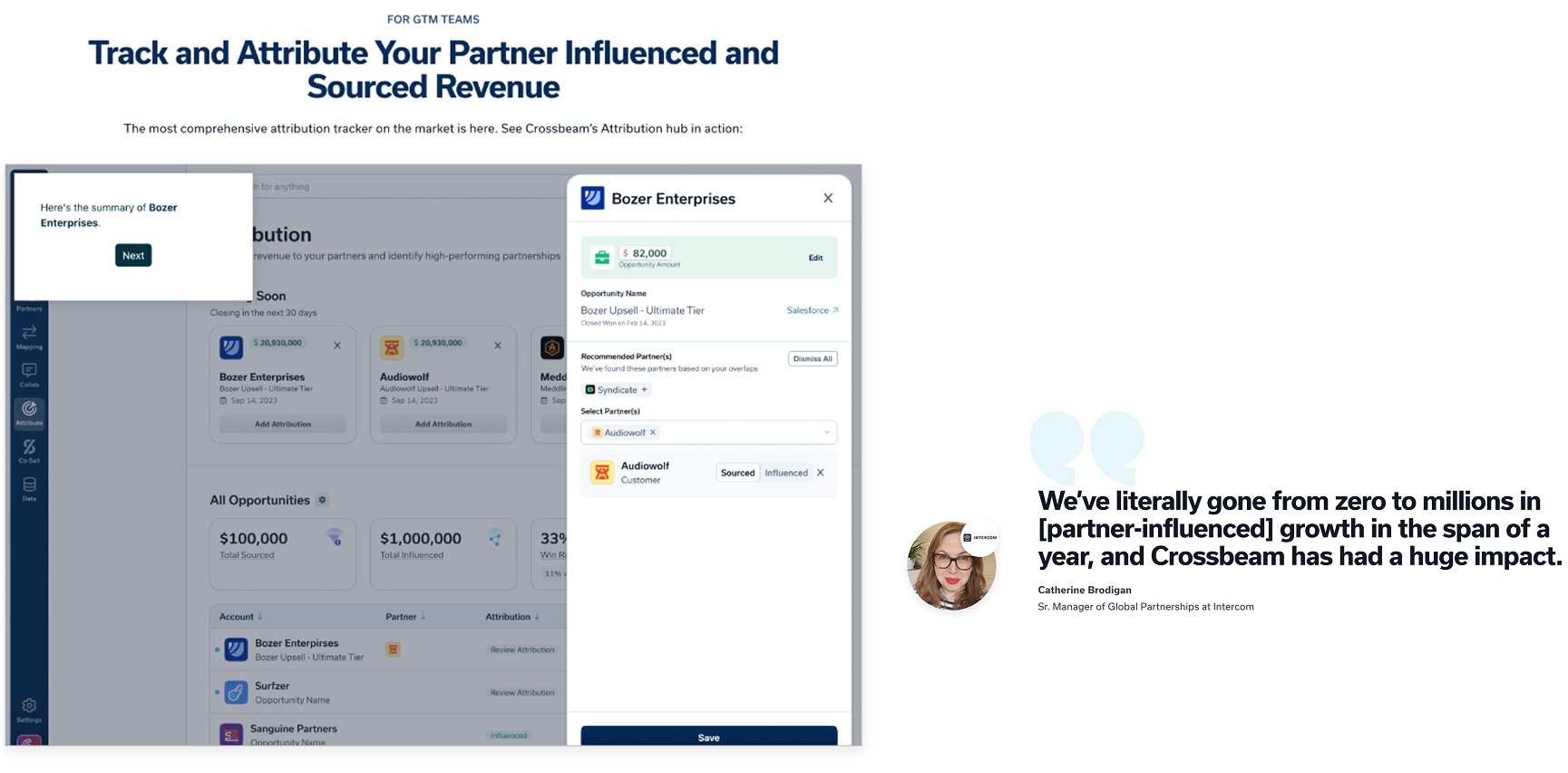
Live Products & Testimonials
Live Products & Testimonials
This work unlocked faster deals today and the ability to guide better ones tomorrow
This work unlocked faster deals today and the ability to guide better ones tomorrow
This work unlocked faster deals today and the ability to guide better ones tomorrow
What it Unlocked
Both features launched in Q3-Q4 2023. The vertical navigation shipped in Q2 and was adopted across the product.
The bigger outcome was foresight. I designed the attribution model to capture not just deal outcomes but the partner interactions that led there, knowing that data would eventually power something smarter. I didn't know what it would be called. But in 2026, Crossbeam launched Deal Navigator, which is exactly that intelligence layer. The foundation was laid in 2023.
Crossbeam Deal Navigator (2026)
What it Unlocked
Both features launched in Q3-Q4 2023. The vertical navigation shipped in Q2 and was adopted across the product.
The bigger outcome was foresight. I designed the attribution model to capture not just deal outcomes but the partner interactions that led there, knowing that data would eventually power something smarter. I didn't know what it would be called. But in 2026, Crossbeam launched Deal Navigator, which is exactly that intelligence layer. The foundation was laid in 2023.
Crossbeam Deal Navigator (2026)
What it Unlocked
Both features launched in Q3-Q4 2023. The vertical navigation shipped in Q2 and was adopted across the product.
The bigger outcome was foresight. I designed the attribution model to capture not just deal outcomes but the partner interactions that led there, knowing that data would eventually power something smarter. I didn't know what it would be called. But in 2026, Crossbeam launched Deal Navigator, which is exactly that intelligence layer. The foundation was laid in 2023.
Crossbeam Deal Navigator (2026)
Learnings
The vision has to be explicit. The data foundation argument was not obvious to everyone at the start. Making it explicit, naming what we were building toward and why capturing the right signals now mattered, was what got alignment on design decisions that felt like scope in the moment but were actually strategy.
Shared language is a design decision. A significant amount of early friction came from the fact that account maps, populations, and shared lists all referred to lists of accounts but worked very differently. Resolving that before design started saved time.
Even when everyone's using the same words, you don't really know if you're aligned until you put something on the screen. Mapping the navigation options visually is what got us all to the same place. I could see it in my head, but that doesn't mean everyone can. Getting to artifacts early is how I level set now.

Can you spot me in the photo?
Learnings
The vision has to be explicit. The data foundation argument was not obvious to everyone at the start. Making it explicit, naming what we were building toward and why capturing the right signals now mattered, was what got alignment on design decisions that felt like scope in the moment but were actually strategy.
Shared language is a design decision. A significant amount of early friction came from the fact that account maps, populations, and shared lists all referred to lists of accounts but worked very differently. Resolving that before design started saved time.
Even when everyone's using the same words, you don't really know if you're aligned until you put something on the screen. Mapping the navigation options visually is what got us all to the same place. I could see it in my head, but that doesn't mean everyone can. Getting to artifacts early is how I level set now.
Can you spot me in the photo?
Learnings
The vision has to be explicit. The data foundation argument was not obvious to everyone at the start. Making it explicit, naming what we were building toward and why capturing the right signals now mattered, was what got alignment on design decisions that felt like scope in the moment but were actually strategy.
Shared language is a design decision. A significant amount of early friction came from the fact that account maps, populations, and shared lists all referred to lists of accounts but worked very differently. Resolving that before design started saved time.
Even when everyone's using the same words, you don't really know if you're aligned until you put something on the screen. Mapping the navigation options visually is what got us all to the same place. I could see it in my head, but that doesn't mean everyone can. Getting to artifacts early is how I level set now.
Can you spot me in the photo?